2026 Travel Guide

Best Volcanoes to Visit

From the glowing lava lakes of Hawaii and the erupting Stromboli to the highland calderas of Iceland and the towering Andes — this is your complete guide to the world's best volcano tours. We cover what to expect, when to go, difficulty level, and how to book for every major volcanic destination.

Wolfgang Beyer (Own work) · CC BY-SA 3.0

Hawaii, USA

Hawaii is one of the most accessible volcano tour destinations on Earth. The Big Island's Hawaii Volcanoes National Park offers everything from drive-up crater viewpoints to multi-day backcountry hikes across active lava fields. Kilauea, one of the world's most active volcanoes, frequently has visible surface activity, while Mauna Loa — the largest active volcano by volume — towers above at over 4,000 meters.

Kilauea

World's most active shield volcano with frequent lava lake activity

Elev.

1,222m

Type

Shield

Last

2025 CE

Best Time

Year-round; lava viewing best at night

Difficulty

Easy

Country

United States

Drive to the Kilauea summit overlook at Jaggar Museum for panoramic views of the Halemaumau crater. The Devastation Trail and Thurston Lava Tube are short, paved walks suitable for all ages. For more adventure, the Kilauea Iki Trail descends into a solidified lava lake. Guided night tours offer the best chance to see glowing lava.

Mauna Loa

Earth's largest active volcano — massive shield spanning half the island

Elev.

4,170m

Type

Shield

Last

2022 CE

Best Time

May to September (drier conditions)

Difficulty

Challenging

Country

United States

The Mauna Loa summit trail is a demanding two-day hike covering 30+ km with 1,900 meters of elevation gain. You'll cross vast lava fields at high altitude where the air is thin and weather can turn quickly. A backcountry cabin near the summit provides overnight shelter. This is a serious mountain hike, not a casual tourist walk.

Haleakala

Maui's dormant giant — famous sunrise and lunar-like crater landscapes

Elev.

3,053m

Type

Shield

Last

1750 CE

Best Time

Year-round; sunrise requires advance reservation

Difficulty

Moderate

Country

United States

The sunrise from Haleakala's summit (3,053m) is legendary and requires a National Park reservation. The Sliding Sands Trail descends into the enormous crater, passing colorful cinder cones and rare silversword plants. Bike tours from the summit down to sea level are a popular alternative. Bring warm layers — temperatures at the top hover near freezing.

Iceland

Iceland sits atop the Mid-Atlantic Ridge where the North American and Eurasian tectonic plates diverge, making it one of the most volcanically active places on Earth. The country offers an extraordinary range of volcanic landscapes — from steaming geothermal fields and recent lava flows to massive ice-covered calderas. The 2021-2024 eruptions on the Reykjanes Peninsula brought global attention and made Iceland the best place to witness a live eruption up close.

Fagradalsfjall

Site of the spectacular 2021-2023 Reykjanes eruptions visible from Reykjavik

Elev.

250m

Type

Fissure vent

Last

2023 CE

Best Time

June to September (24-hour daylight, easier trails)

Difficulty

Moderate

Country

Iceland

The Fagradalsfjall eruption site is just 40 km from Reykjavik, making it one of the most accessible recent eruption sites anywhere. The hike to the still-steaming lava fields takes 1-2 hours over rough terrain. You'll walk across brand-new land, see fresh lava formations, and feel heat radiating from the ground. Check current eruption status before visiting.

Krafla

Dramatic caldera with the turquoise Viti crater lake and steaming vents

Elev.

800m

Type

Caldera

Last

1984 CE

Best Time

June to August

Difficulty

Easy

Country

Iceland

Krafla in northern Iceland offers easy access to dramatic volcanic features. The short walk to Viti explosion crater reveals a stunning blue-green lake. The surrounding Leirhnjukur lava field from the 1975-1984 eruptions is still warm, with steam vents and bubbling mud pots. The Myvatn Nature Baths nearby make a perfect post-hike stop.

Askja

Remote highland caldera with a swimmable geothermal lake

Elev.

1,080m

Type

Stratovolcano

Last

1961 CE

Best Time

Late June to early September (highland roads open)

Difficulty

Challenging

Country

Iceland

Reaching Askja requires a 4x4 vehicle and crossing highland F-roads that are only open in summer. The reward is one of Iceland's most spectacular volcanic landscapes — an enormous caldera with the warm, milky-blue Lake Viti (swimmable at ~25 degrees C) set within the larger Lake Oskjuvatn. The hike from the parking area takes about 45 minutes each way.

Eyjafjallajokull

The ice-capped volcano whose 2010 eruption shut down European airspace

Elev.

1,651m

Type

Stratovolcano

Last

2010 CE

Best Time

June to August

Difficulty

Challenging

Country

Iceland

You won't summit Eyjafjallajokull without glacier experience and guides, but the surrounding area is spectacular. Guided glacier walks on the ice cap, visits to the Seljalandsfoss and Skogafoss waterfalls fed by its glacial melt, and the Thorsmork valley behind the volcano offer world-class hiking. The LAVA Centre in Hvolsvollur provides an excellent eruption exhibition.

Italy

Italy is home to some of the most historically significant and accessible volcanoes in the world. Mount Vesuvius overlooks the ruins of Pompeii, Mount Etna is Europe's tallest and most active volcano, and Stromboli has been erupting continuously for over 2,000 years. All three can be visited as day trips from major Italian cities, combining world-class volcanology with incredible food, culture, and history.

Etna

Europe's tallest active volcano with near-continuous summit eruptions

Elev.

3,357m

Type

Stratovolcano(es)

Last

2025 CE

Best Time

April to October (cable car operates year-round)

Difficulty

Moderate

Country

Italy

Take the Funivia dell'Etna cable car to 2,500m, then a 4x4 shuttle to 2,900m. From there, guided summit hikes reach the active craters above 3,300m where you can peer into steaming vents and walk across fresh lava. Lower-altitude adventures include lava tube tours, wine tasting on volcanic soils, and the spectacular Alcantara Gorge. Etna erupts frequently, so summit access depends on conditions.

Stromboli

The 'Lighthouse of the Mediterranean' — erupting every 15-20 minutes

Elev.

924m

Type

Stratovolcano

Last

2025 CE

Best Time

April to October (eruptions visible year-round)

Difficulty

Challenging

Country

Italy

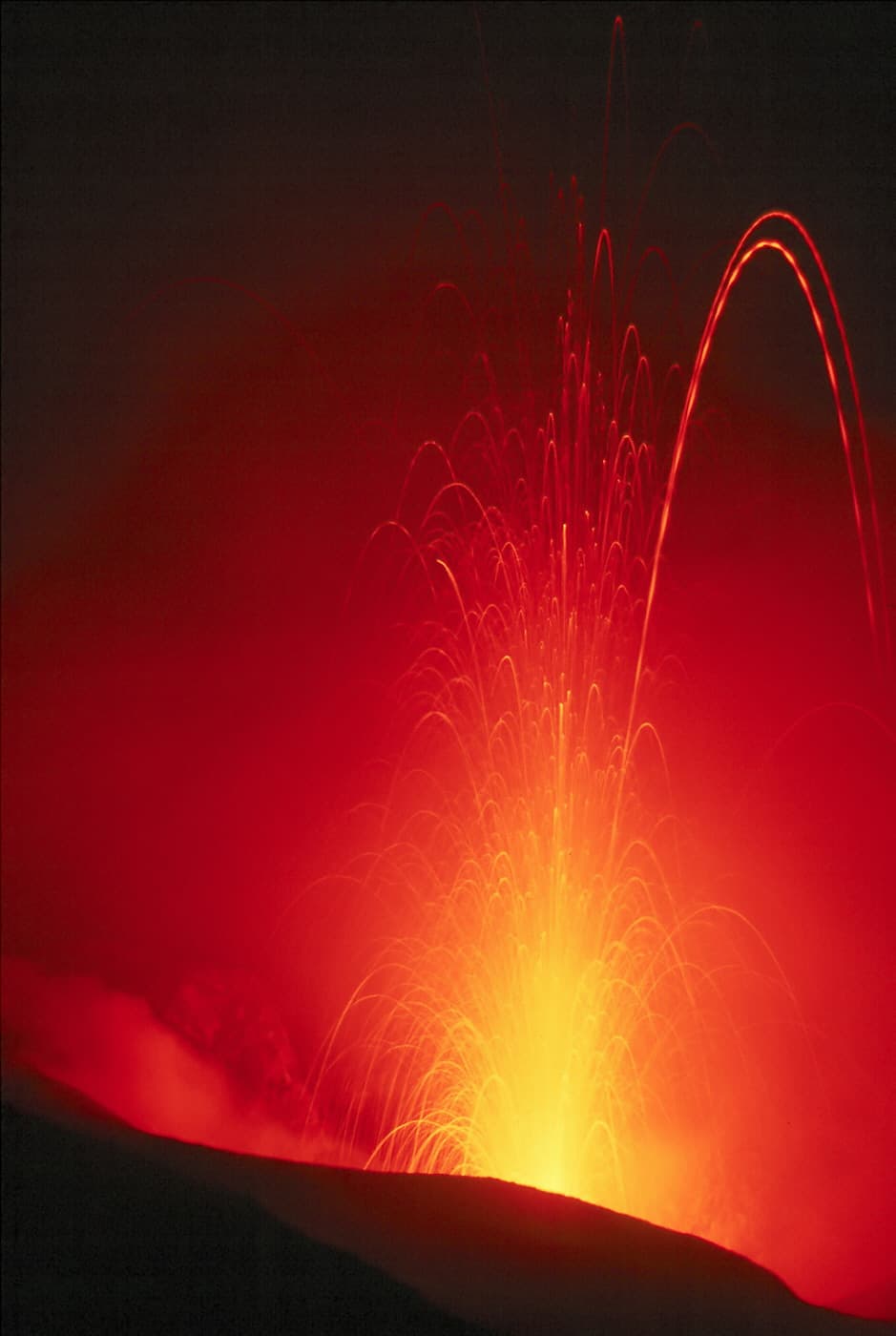
Stromboli offers the rare chance to watch regular volcanic explosions from just a few hundred meters away. The guided summit hike (924m) takes about 3 hours up and begins in the late afternoon to arrive at the crater rim at sunset. You'll watch incandescent lava bombs shoot hundreds of meters into the darkening sky. Only 20 people are allowed at the summit at a time. Boat tours offer views of the Sciara del Fuoco lava slide from the sea.

Vesuvius

The volcano that destroyed Pompeii — combine with ancient ruins tours

Elev.

1,281m

Type

Stratovolcano

Last

1944 CE

Best Time

April to October (trails open year-round except severe weather)

Difficulty

Easy

Country

Italy

The hike to the summit of Vesuvius takes just 20-30 minutes from the parking area on a well-maintained gravel path. At the rim, you'll gaze into the 300-meter-deep crater and enjoy sweeping views over the Bay of Naples. Most visitors pair the Vesuvius hike with a tour of the Pompeii or Herculaneum archaeological sites below — an unforgettable combination of natural history and ancient civilization.

Indonesia

Indonesia is the world's most volcanically active nation, with over 130 active volcanoes stretching across 17,000 islands. From the turquoise acid lakes of Kawah Ijen to the ancient caldera of Tengger (Mount Bromo), Indonesian volcanoes offer some of the most dramatic landscapes on the planet — often at a fraction of the cost of European or Hawaiian tours. Java and Bali are the most popular volcano touring regions, with excellent infrastructure and experienced local guides.

Tengger Caldera

Iconic sunrise over the Sea of Sand caldera — Indonesia's most photographed volcano

Elev.

2,329m

Type

Stratovolcano(es)

Last

2023 CE

Best Time

April to October (dry season)

Difficulty

Easy

Country

Indonesia

The classic Mount Bromo experience begins with a 3 AM jeep ride to the Penanjakan viewpoint for a legendary sunrise over the Tengger caldera. As dawn breaks, the smoking cone of Bromo appears amid a vast volcanic plain called the Sea of Sand. You can then hike or ride horses across the caldera floor and climb the 250 steps to Bromo's crater rim. The entire experience takes about 5 hours and is suitable for most fitness levels.

Ijen

Blue flames, turquoise acid lake, and sulfur miners at work

Elev.

2,769m

Type

Stratovolcano(es)

Last

1999 CE

Best Time

April to October (dry season; blue flames visible year-round at night)

Difficulty

Moderate

Country

Indonesia

Kawah Ijen is famous for its otherworldly blue flames — ignited sulfuric gas that burns electric blue in the darkness. The hike starts at 1 AM to reach the crater before dawn. You'll descend to the world's largest acidic volcanic lake, watch sulfur miners carry 70kg loads from the fumaroles, then emerge at the crater rim for sunrise. A gas mask is essential (provided by guides). This is an unforgettable, once-in-a-lifetime experience.

Agung

Bali's sacred volcano — the island's highest and holiest peak

Elev.

2,997m

Type

Stratovolcano

Last

2022 CE

Best Time

April to October (dry season)

Difficulty

Expert

Country

Indonesia

Mount Agung is a serious climb starting at midnight for a sunrise summit. The 6-8 hour ascent gains nearly 2,000 meters on steep, loose volcanic terrain. At the top, peer into the active crater and watch the shadow of Agung stretch across Bali below. The volcano erupted as recently as 2019, so check current alert levels. Most climbers hire mandatory local guides from Besakih Temple. An easier alternative is the sunrise hike on neighboring Mount Batur.

Rinjani

Lombok's giant with a stunning crater lake and hot springs

Elev.

3,726m

Type

Stratovolcano

Last

2016 CE

Best Time

April to October (dry season)

Difficulty

Expert

Country

Indonesia

Mount Rinjani is a multi-day trek to Indonesia's second-highest volcano. The standard 3-day/2-night itinerary includes camping at the crater rim (2,639m) overlooking the turquoise Segara Anak crater lake, descending to natural hot springs on the lake shore, and optionally summiting the peak at 3,726m. This is a physically demanding trek with steep terrain and altitude. Porters carry most gear, and organized group treks depart daily from Senaru.

Japan

Japan's 111 active volcanoes are woven into the country's culture, spirituality, and daily life. Mount Fuji is the world's most climbed volcano, while Mount Aso on Kyushu contains one of the largest calderas on Earth. Japanese volcano tourism benefits from world-class infrastructure — bullet trains, well-marked trails, mountain huts, and onsen (hot spring) towns built directly over volcanic heat. Many volcanoes can be combined with visits to nearby hot spring resorts.

Fujisan

Japan's iconic peak — the world's most climbed volcano at 3,776m

Elev.

3,776m

Type

Stratovolcano

Last

1708 CE

Best Time

July to early September (official climbing season)

Difficulty

Challenging

Country

Japan

Climbing Mount Fuji is a bucket-list experience for millions. The most popular Yoshida Trail takes 5-7 hours to ascend and 3-4 hours to descend, with most climbers overnighting in a mountain hut at the 7th or 8th station to summit for sunrise (goraiko). The climb is not technically difficult but is physically demanding due to altitude and steep scree slopes. Outside climbing season, the trails are officially closed due to snow and weather.

Asosan

One of the world's largest calderas with an active, steaming crater

Elev.

1,592m

Type

Caldera

Last

2021 CE

Best Time

March to November (crater access weather-dependent)

Difficulty

Easy

Country

Japan

Mount Aso's Nakadake crater is one of the few places where you can drive right up to an actively steaming volcanic vent. A ropeway and road lead to the crater rim where you'll look down at a turquoise acid lake and billowing sulfurous gases. The broader Aso caldera is 25 km wide and contains entire towns, rice paddies, and the lush Kusasenri grassland. Crater access closes frequently due to volcanic gas levels.

Aira

Japan's most active volcano erupts hundreds of times per year

Elev.

1,117m

Type

Caldera

Last

2025 CE

Best Time

Year-round (eruptions are constant)

Difficulty

Easy

Country

Japan

Sakurajima sits in Kagoshima Bay, visible from the city of Kagoshima — Japan's 'Naples.' The volcano erupts so frequently (600+ times per year) that you can almost always see ash plumes rising from the summit. A short ferry ride brings you to the volcano where you can drive or cycle around the base, visit the buried torii gate at Kurokami, and view the Showa crater from designated observation points. Summit access is prohibited due to constant activity.

New Zealand

New Zealand's Taupo Volcanic Zone on the North Island is one of the most active volcanic regions on Earth. The country offers an extraordinary diversity of volcanic experiences, from the alpine crossing of Tongariro (the filming location for Mount Doom) to the geothermal wonderlands of Rotorua. New Zealand's volcanoes are deeply significant to Maori culture, and many tours incorporate indigenous perspectives alongside geological interpretation.

Tongariro

The legendary Tongariro Alpine Crossing — New Zealand's greatest day hike

Elev.

1,978m

Type

Stratovolcano(es)

Last

2012 CE

Best Time

November to April (summer; winter requires alpine gear)

Difficulty

Challenging

Country

New Zealand

The Tongariro Alpine Crossing is consistently rated one of the world's best day hikes. The 19.4 km traverse crosses active volcanic terrain including the Red Crater, the vivid Emerald Lakes, and the Blue Lake — all set against the dramatic backdrop of Mount Ngauruhoe (used as Mount Doom in The Lord of the Rings). Allow 6-8 hours. The terrain is exposed and weather changes rapidly, so proper gear is essential.

Ruapehu

Snow-capped active volcano with a crater lake and ski fields

Elev.

2,797m

Type

Stratovolcano

Last

2007 CE

Best Time

December to March (hiking); June to October (skiing)

Difficulty

Moderate

Country

New Zealand

Ruapehu is the remarkable combination of an active volcano and a commercial ski resort. In summer, hike to the Crater Lake — a warm, acidic lake perched at 2,530m in the active crater. The summit climb is a full-day expedition requiring some scrambling. In winter, ski or snowboard on the slopes of Whakapapa and Turoa, knowing that volcanic heat melts the snow beneath your feet. The volcano last erupted in 2007.

Whakaari/White Island

New Zealand's most active marine volcano — a volcanic island in the Bay of Plenty

Elev.

294m

Type

Stratovolcano(es)

Last

2025 CE

Best Time

October to April (tour boats operate weather-dependent)

Difficulty

Moderate

Country

New Zealand

Whakaari/White Island is a privately owned active volcanic island 48 km offshore in the Bay of Plenty. Following the tragic 2019 eruption that killed 22 people, the island is currently closed to visitors. Scenic helicopter and boat tours still operate around the island, offering views of its steaming crater and yellow sulfur vents from a safe distance. Check current access status before planning a visit.

Central America

Central America's volcanic arc stretches from Guatemala to Costa Rica, offering some of the most affordable and accessible volcano tours in the world. Guatemala's Acatenango overnight hike with views of erupting Fuego is one of the most popular volcano experiences anywhere. Costa Rica's national parks provide safe, well-maintained access to active craters, while Nicaragua's volcanic landscapes are among the least crowded in the region.

Acatenango

Camp at 3,976m and watch Fuego erupt all night — the ultimate volcano experience

Elev.

3,976m

Type

Stratovolcano(es)

Last

1972 CE

Best Time

November to March (dry season; clearest views)

Difficulty

Challenging

Country

Guatemala

The Acatenango overnight hike is Central America's premier volcano experience. The steep 5-6 hour climb through cloud forest to the summit camp at 3,976m is grueling, but the payoff is extraordinary — from your tent, you watch neighboring Volcan de Fuego erupt every 15-30 minutes throughout the night, sending lava and incandescent rocks down its flanks. Dawn reveals five volcanoes, two oceans, and the Guatemalan highlands below.

Poas

Drive-up access to one of the world's largest active craters

Elev.

2,697m

Type

Stratovolcano

Last

2025 CE

Best Time

December to April (dry season; morning visits best for clear views)

Difficulty

Easy

Country

Costa Rica

Poas Volcano National Park in Costa Rica offers one of the easiest active volcano experiences on Earth. A paved path leads from the parking lot to a viewing platform overlooking the 300-meter-deep, 1.3 km-wide crater with its turquoise acid lake. Phreatic eruptions occur periodically, so the park enforces timed entry and sometimes closes. The cloud forest trails around the crater are excellent for birdwatching.

Masaya

Peer directly into a glowing lava lake from the crater's edge

Elev.

594m

Type

Caldera

Last

2025 CE

Best Time

Year-round (lava lake best viewed after dark)

Difficulty

Easy

Country

Nicaragua

Masaya in Nicaragua is one of only a few volcanoes where you can drive right up to the rim of an active crater. Since 2015, a persistent lava lake has glowed at the bottom of the Santiago crater, visible especially after sunset. Night tours are the highlight — you'll stand at the fenced rim and look straight down at roiling molten rock. The visit is short (about 20 minutes at the rim) but utterly dramatic. Bats emerge from the crater at dusk.

Pacaya

Hike across fresh lava and roast marshmallows on volcanic vents

Elev.

2,569m

Type

Complex

Last

2021 CE

Best Time

November to April (dry season)

Difficulty

Moderate

Country

Guatemala

Pacaya is Guatemala's most accessible active volcano, just 90 minutes from Antigua. The 2-hour hike ascends through pine forest before reaching the black lava fields from recent eruptions. You can walk across still-warm lava flows and — in the iconic Pacaya experience — roast marshmallows over volcanic heat vents. On clear days, you can see three other volcanoes from the summit ridge. Guided tours from Antigua are inexpensive and run daily.

The Andes (South America)

The Andes volcanic arc stretches 7,000 km along South America's western coast, containing some of the highest and most spectacular volcanoes on Earth. From the glacier-clad cone of Ecuador's Cotopaxi to the lava-lit summit of Chile's Villarrica, Andean volcanoes combine extreme altitude with stunning beauty. Many sit above 5,000 meters, making proper acclimatization essential. The volcanoes of Ecuador, Peru, and Chile offer the most established touring infrastructure.

Cotopaxi

One of the world's highest active volcanoes — perfect glacier-capped cone at 5,911m

Elev.

5,911m

Type

Stratovolcano

Last

2023 CE

Best Time

June to September and December to January (dry seasons)

Difficulty

Expert

Country

Ecuador

Cotopaxi summit attempts start at midnight from the refuge at 4,800m. Climbers ascend glaciated slopes using crampons and ice axes, roped to a guide, reaching the crater rim at 5,911m for a dawn panorama of the Ecuadorian Andes. The climb requires prior altitude acclimatization and basic mountaineering skills. For non-climbers, the mountain bike descent from the refuge is world-class, and the high-altitude paramo hiking around the base is spectacular.

Villarrica

One of only a handful of volcanoes with a permanent lava lake

Elev.

2,847m

Type

Stratovolcano

Last

2025 CE

Best Time

November to March (Chilean summer)

Difficulty

Challenging

Country

Chile

Villarrica in Chile's Lake District is one of the most popular volcano climbs in South America. The 6-8 hour round trip ascends snowfields to the summit crater where you can look down at (and hear) the bubbling lava lake 200 meters below. The descent includes a thrilling ice slide on your backside. The town of Pucon at the base is Chile's adventure tourism capital, with hot springs, rafting, and skiing available.

Misti, El

Towering over Arequipa, Peru — the perfect volcanic cone at 5,793m

Elev.

5,793m

Type

Stratovolcano

Last

1985 CE

Best Time

May to November (dry season)

Difficulty

Expert

Country

Peru

El Misti rises directly above Peru's second-largest city, Arequipa, creating one of the most dramatic city-volcano combinations on Earth. The standard 2-day climb involves camping at 4,500m and summiting the next morning over loose volcanic scree. The crater still emits sulfurous gases. The climb is not technically difficult but the extreme altitude makes it physically demanding. Excellent acclimatization in Arequipa (2,335m) is essential before attempting.

Osorno

The 'Fuji of South America' — symmetrical cone reflected in Lake Llanquihue

Elev.

2,659m

Type

Stratovolcano

Last

1869 CE

Best Time

November to March (hiking); June to September (skiing)

Difficulty

Moderate

Country

Chile

Osorno's near-perfect cone shape and glacier-covered summit make it one of the most photogenic volcanoes in the Americas. A chair lift and cable car operate on its slopes (ski resort in winter), providing easy access to 1,800m. Guided summit climbs are available but require crampons and ropes. The surrounding Lake District, with the lakeside town of Puerto Varas and the Petrohue waterfalls, makes Osorno part of an exceptional volcanic landscape.

Volcano Tour Safety Tips

Check Alert Levels Before You Go

Always check the current volcanic alert level through local authorities or the USGS Volcano Hazards Program. Alert levels can change rapidly, and areas open one day may be closed the next.

Hire a Local Guide

Local guides know the terrain, current conditions, and escape routes. Many volcanoes legally require a guide for summit access. Even where optional, a knowledgeable guide dramatically improves both safety and experience.

Prepare for Extreme Conditions

Volcanic summits can be bitterly cold, even in the tropics. Bring layers, rain gear, sun protection, and plenty of water. High-altitude volcanoes (above 3,000m) require acclimatization to prevent altitude sickness.

Respect Exclusion Zones

Volcanic exclusion zones exist for a reason. Pyroclastic flows travel at 700+ km/h, volcanic bombs are ejected kilometers from craters, and toxic gas accumulates in low areas. Never cross barriers or ignore warning signs.

Start Early, Finish Early

Most volcano hikes begin before dawn — partly for sunrise views, but also because afternoon clouds, rain, and thunderstorms are common at altitude. Plan to be descending by midday for tropical and equatorial volcanoes.

Carry a Gas Mask for Active Craters

Volcanic gases (SO2, CO2, HCl) can be lethal in high concentrations. When visiting actively degassing volcanoes like Ijen, Masaya, or Aso, carry a proper gas mask with acid gas filters. People with asthma or respiratory conditions should exercise extra caution.

Explore More