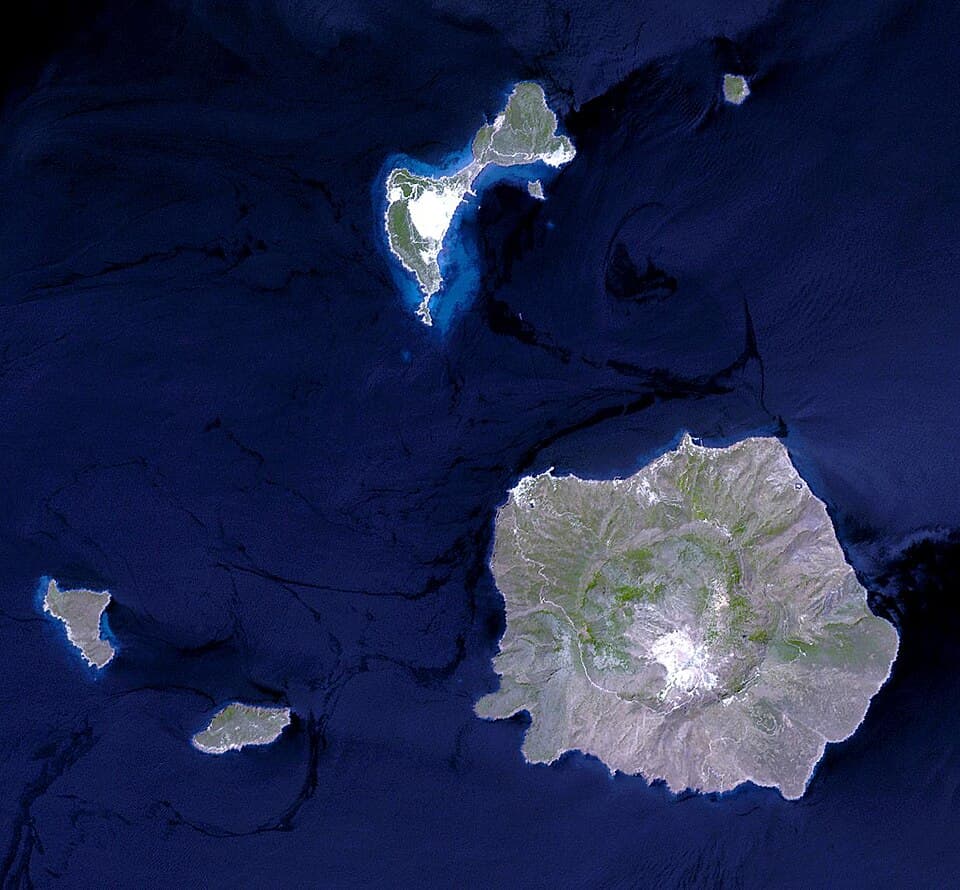
About Nisyros
Nisyros is a stratovolcano rising to 698 meters (2,290 feet) in Greece's European Volcanic Regions. Its last known eruption was in 1888 CE. The volcano has produced 4 recorded eruptions, with a maximum Volcanic Explosivity Index (VEI) of 2.
Geography & Climate
Nisyros is located in Greece, within the Hellenic Volcanic Arc of the broader European Volcanic Regions. Situated at 36.59° N, 27.16° E in the Northern Hemisphere, the volcano lies within a temperate climate zone. With a summit elevation of 698 meters above sea level, Nisyros is a moderately sized peak that remains accessible to hikers and researchers for much of the year. The volcanic landform is characterized as a composite, which describes the physical shape and structure of the volcanic edifice as observed from the surface.
Geological Context
Nisyros sits in a subduction zone, where one tectonic plate dives beneath another, creating intense heat and pressure that generates magma. Subduction zones are responsible for many of the world's most explosive volcanoes and deadliest eruptions. For communities in Greece near Nisyros, this tectonic setting means the volcano is capable of producing powerful explosive eruptions, pyroclastic flows, and lahars that can threaten populated areas within tens of kilometers of the summit. The dominant rock type is dacite, an intermediate to silica-rich volcanic rock. This composition typically produces more viscous magma, leading to more explosive eruptions with ash columns and pyroclastic flows. Andesitic and dacitic magmas build pressure before erupting, which is why volcanoes with this rock chemistry are often associated with Plinian-style eruptions that can send ash tens of kilometers into the atmosphere and disrupt aviation across entire regions.
Eruption History Summary
Nisyros has 4 recorded eruptions in the geological database, spanning from 1422 CE to 1888 CE. The most powerful recorded event was an explosive event producing ash plumes up to several kilometers in 1888 CE, reaching VEI 2 on the Volcanic Explosivity Index. These eruptions span roughly 466 years of volcanic history.
GVP Reference Summary
The easternmost volcano of the Aegean arc forms the 9-km-wide island of Nisyros, which is truncated by a 3-4 km wide caldera. The island was constructed during the past 150,000 years, with three cone-building stages including explosive and effusive andesitic eruptions and effusive and extrusive dacitic and rhyolitic activity. The age of the caldera is variously considered to be less than 24,000 years before present (BP) (Keller et al., 1990) and older than 44,000 years BP (Limburg and Varekamp, 1991). Five large post-caldera lava domes completely fill the western part of the caldera. The NE-most (Boriatiko) and SW-most (Karaviotis) lava domes and flows are significantly younger than the other domes. A sixth post-caldera dome, outside the SW caldera rim, produced lava flows that reached the coast. Historical phreatic eruptions occurred from craters within the caldera between 1422 and 1888. Intense hydrothermal activity continues in the form of many fumaroles on the caldera floor and hot springs along the coast.
— Smithsonian Institution, Global Volcanism Program
4 Recorded Eruptions
How Nisyros's 4 size-rated eruptions break down by Volcanic Explosivity Index. Select a bar to see what that size means.
Explosive — ash plumes reaching 1–5 km, localized impact.
Of Nisyros's 4 size-rated eruptions on record, the most common was VEI 2 (4 of 4, 100%). It is strikingly consistent, erupting at close to the same size again and again. No eruption on record exceeded VEI 2.
Based on the Smithsonian GVP eruption record. This describes Nisyros's past eruptions only — it does not predict future activity. What is the VEI? · Most explosive volcanoes
| Year | VEI | Type | Area |
|---|---|---|---|
| 1888 | 2 | Confirmed Eruption | Polyvotis Micros |
| 1873 | 2 | Confirmed Eruption | Plegathon and Polyvotis |
| 1871 | 2 | Confirmed Eruption | Plegathon and Polyvotis |
| 1422 | 2 | Confirmed Eruption | — |
Real-Time Data
Frequently Asked Questions About Nisyros
Is Nisyros an active volcano?+
Nisyros is classified as active based on credible evidence of past eruptions. Although its last known eruption was in 1888 CE, volcanologists consider it capable of erupting again.
When did Nisyros last erupt?+
The most recent recorded eruption of Nisyros occurred in 1888 CE with a Volcanic Explosivity Index (VEI) of 2. The eruption was classified as a "Confirmed Eruption." Nisyros has 4 recorded eruptions in total.
How high is Nisyros?+
Nisyros has a summit elevation of 698 meters (2,290 feet) above sea level. At 698 meters, it is a relatively low-elevation volcano.
What type of volcano is Nisyros?+
Nisyros is classified as a Stratovolcano. Stratovolcanoes (also called composite volcanoes) are steep, conical volcanoes built up by many layers of hardened lava, tephra, and volcanic ash. They are among the most common and dangerous types, known for explosive eruptions.
Where is Nisyros located?+
Nisyros is located in Greece, in the European Volcanic Regions. More specifically, it lies within the Hellenic Volcanic Arc. Its exact coordinates are 36.589° latitude, 27.155° longitude.
Is it safe to visit Nisyros?+
Nisyros can generally be visited, but as with any volcano, visitors should check local conditions and any advisory notices before traveling. Greece may have specific regulations for accessing volcanic areas. Guided tours are often the safest and most informative way to experience a volcano.