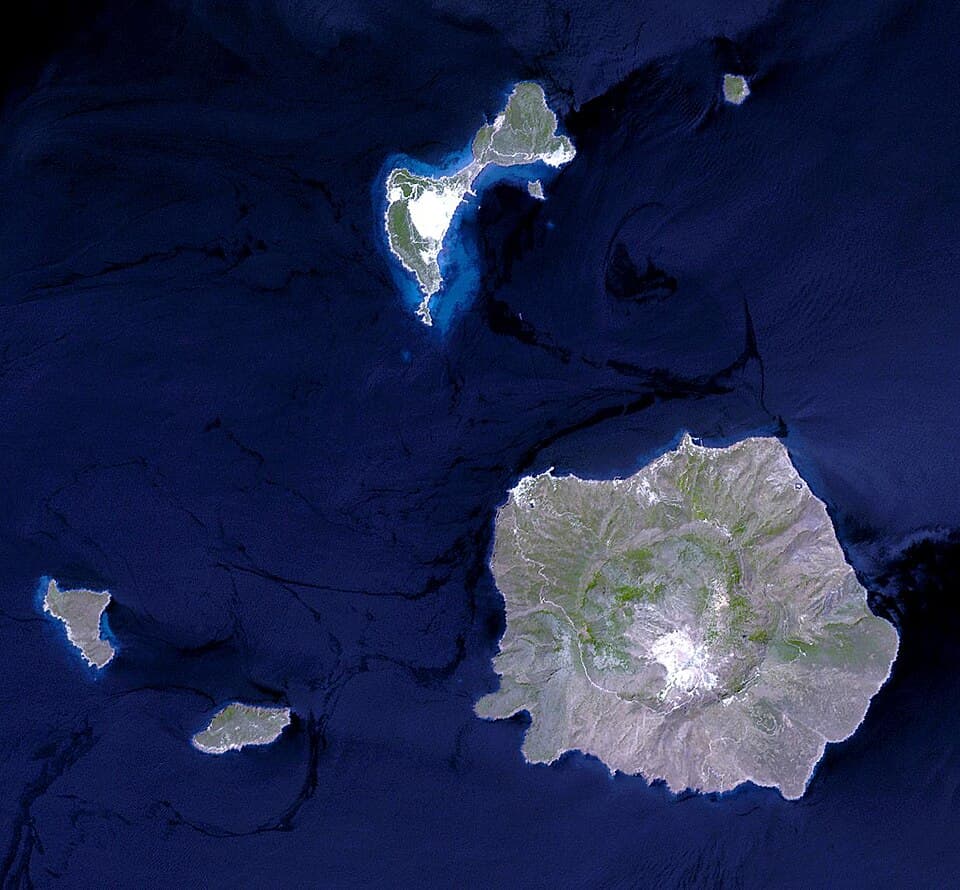
About Kolumbo
Kolumbo is a complex rising to -18 meters (-59 feet) in Greece's European Volcanic Regions. Its last known eruption was in 1650 CE. The volcano has produced 1 recorded eruption, with a maximum Volcanic Explosivity Index (VEI) of 4.
Geography & Climate
Kolumbo is located in Greece, within the Hellenic Volcanic Arc of the broader European Volcanic Regions. Situated at 36.52° N, 25.48° E in the Northern Hemisphere, the volcano lies within a temperate climate zone. With an elevation of -18 meters — below sea level — Kolumbo is a submarine or submerged volcanic feature. Submarine volcanoes make up the majority of Earth's volcanic activity, though most eruptions go unobserved beneath the ocean surface. The volcanic landform is characterized as a cluster, which describes the physical shape and structure of the volcanic edifice as observed from the surface.
Eruption History Summary
Kolumbo has 1 recorded eruption in the geological database, spanning from 1650 CE to 1650 CE. The most powerful recorded event was a cataclysmic eruption with ash columns reaching the stratosphere in 1650 CE, reaching VEI 4 on the Volcanic Explosivity Index.
Significance
With a maximum recorded VEI of 4, Kolumbo has demonstrated the capacity for significant explosive eruptions that can impact regional aviation, agriculture, and communities tens of kilometers from the summit. VEI 4 eruptions produce ash columns reaching 15-25 kilometers into the atmosphere.
GVP Reference Summary
The submarine Kolumbo volcano is about 15 km NE of the center of the Santorini caldera. Although previously considered to be part of a volcanic field associated with Santorini along a fault zone, Klaver et al. (2016) concluded that Kolumbo was a distinct volcanic system with "a deep differentiation history" based on "a signature of high 208Pb/206Pb compared to Santorini". A strong eruption during September-November 1650 CE killed over 60 people, along with livestock, due to toxic gas emissions; ashfall reached mainland Turkey, and an island of pumice rose above sea level but was rapidly eroded. Klaver et al. (2016) describe the current crater as roughly oval-shaped with a diameter of ~1.7 km, with the crater floor at 500 m below sea level, and the highest point of the crater rim at -18 m. A chain of 19 smaller volcanic features extends ~10 km NE from this primary crater.
— Smithsonian Institution, Global Volcanism Program
1 Recorded Eruption
| Year | VEI | Type | Area |
|---|---|---|---|
| 1650 | 4 | Confirmed Eruption | Kolumbo crater |
Real-Time Data
Frequently Asked Questions About Kolumbo
Is Kolumbo an active volcano?+
Kolumbo is not currently classified as active. Its activity evidence is listed as "Eruption Dated." The last known eruption was in 1650 CE. However, no volcano is ever considered permanently extinct.
When did Kolumbo last erupt?+
The most recent recorded eruption of Kolumbo occurred in 1650 CE with a Volcanic Explosivity Index (VEI) of 4. The eruption was classified as a "Confirmed Eruption." Kolumbo has 1 recorded eruption in total.
How high is Kolumbo?+
Kolumbo has a summit elevation of -18 meters (-59 feet) above sea level. With an elevation of -18 meters (below sea level), this is a submarine or submerged volcanic feature.
What type of volcano is Kolumbo?+
Kolumbo is classified as a Complex. Complex volcanoes have distinct geological characteristics that set them apart from other volcanic types.
Where is Kolumbo located?+
Kolumbo is located in Greece, in the European Volcanic Regions. More specifically, it lies within the Hellenic Volcanic Arc. Its exact coordinates are 36.524° latitude, 25.483° longitude.
Is it safe to visit Kolumbo?+
Kolumbo can generally be visited, but as with any volcano, visitors should check local conditions and any advisory notices before traveling. Greece may have specific regulations for accessing volcanic areas. Guided tours are often the safest and most informative way to experience a volcano.