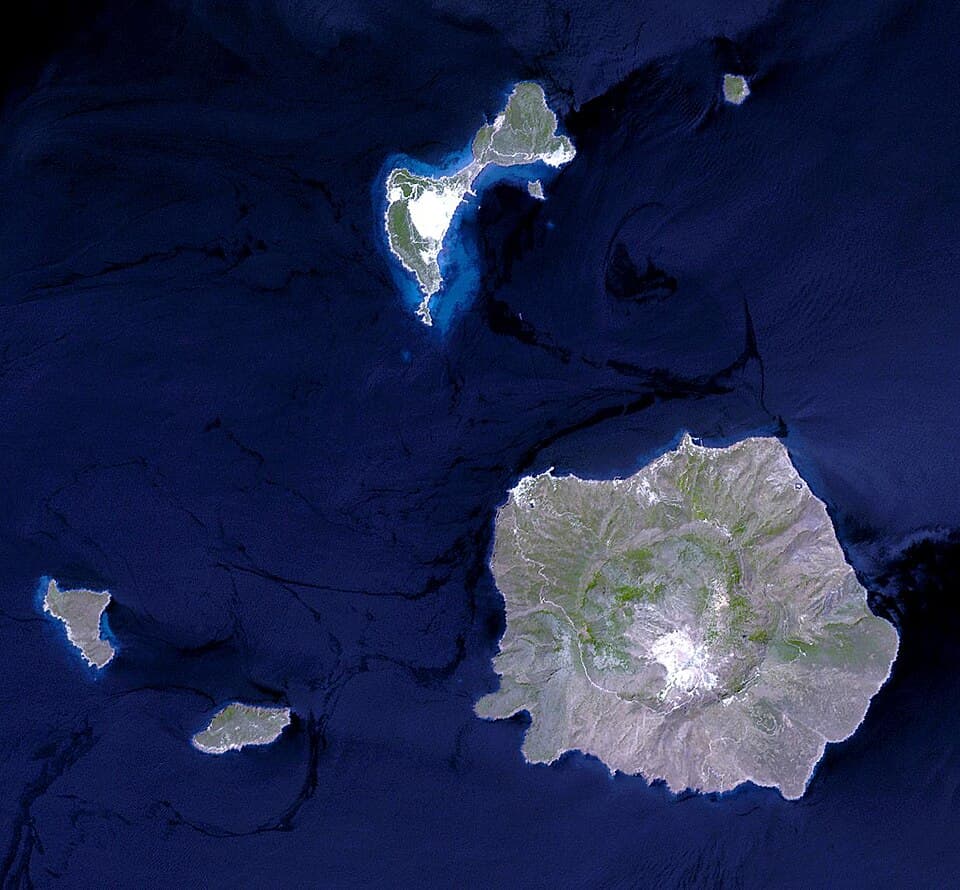
About Santorini
Santorini is a shield(s) rising to 367 meters (1,204 feet) in Greece's European Volcanic Regions. It last erupted in 1950 CE, and volcanologists consider it an active volcanic system. The volcano has produced 11 recorded eruptions, with a maximum Volcanic Explosivity Index (VEI) of 7.
Geography & Climate
Santorini is located in Greece, within the Hellenic Volcanic Arc of the broader European Volcanic Regions. Situated at 36.40° N, 25.40° E in the Northern Hemisphere, the volcano lies within a temperate climate zone. At just 367 meters above sea level, Santorini is a relatively low-elevation volcanic feature. Despite its modest height, it remains an active geological formation with the same underlying magmatic processes as its taller counterparts. The volcanic landform is characterized as a shield, which describes the physical shape and structure of the volcanic edifice as observed from the surface.
Geological Context
Santorini sits in a subduction zone, where one tectonic plate dives beneath another, creating intense heat and pressure that generates magma. Subduction zones are responsible for many of the world's most explosive volcanoes and deadliest eruptions. For communities in Greece near Santorini, this tectonic setting means the volcano is capable of producing powerful explosive eruptions, pyroclastic flows, and lahars that can threaten populated areas within tens of kilometers of the summit. The dominant rock type is dacite, an intermediate to silica-rich volcanic rock. This composition typically produces more viscous magma, leading to more explosive eruptions with ash columns and pyroclastic flows. Andesitic and dacitic magmas build pressure before erupting, which is why volcanoes with this rock chemistry are often associated with Plinian-style eruptions that can send ash tens of kilometers into the atmosphere and disrupt aviation across entire regions.
Eruption History Summary
Santorini has 11 recorded eruptions in the geological database, spanning from 1610 BCE to 1950 CE. The most powerful recorded event was a super-colossal eruption, among the largest in recorded geological history in 1610 BCE, reaching VEI 7 on the Volcanic Explosivity Index. Notable eruptions include 1707 CE (VEI 3), 1570 CE (VEI 3), 726 CE (VEI 4). This level of eruptive frequency indicates a persistently active volcanic system that warrants ongoing monitoring. The most recent eruption in 1950 CE places this volcano within the modern era of volcanological observation.
Significance
Santorini has produced at least one eruption of VEI 7 or higher, placing it among the most powerful volcanic systems ever documented on Earth. Eruptions of this magnitude eject hundreds of cubic kilometers of material, can cause volcanic winters lasting years, and have historically led to crop failures and famine across continents. With 11 recorded eruptions, Santorini has a substantial eruptive history that provides valuable data for understanding volcanic behavior and assessing future hazards in the European Volcanic Regions region. Given its recent activity, Santorini is closely monitored by geological survey organizations to provide early warning of future unrest.
GVP Reference Summary
Santorini (Thera), in the Aegean Sea, has steep-walled caldera rim with villages that overlook an active volcanic island in the center of a caldera bay. The circular island group is composed of overlapping shield volcanoes cut by at least four partially overlapping calderas. The oldest southern caldera was formed about 180,000 years before present (BP), followed by the Skaros caldera about 70,000 BP, and then the Cape Riva caldera about 21,000 BP. The youngest caldera formed about 3,600 BP (around 1600 BCE) during the Late-Bronze-Age Minoan eruption that forced abandonment of the island. Post-Minoan eruptions beginning in 197 BCE constructed a series of lava domes and flows that form two islands near the center of the caldera. The latest eruption produced a small lava dome and flow in 1950, accompanied by explosive activity.
— Smithsonian Institution, Global Volcanism Program
11 Recorded Eruptions
How Santorini's 11 size-rated eruptions break down by Volcanic Explosivity Index. Select a bar to see what that size means.
Explosive — ash plumes reaching 1–5 km, localized impact.
Of Santorini's 11 size-rated eruptions on record, the most common was VEI 2 (5 of 11, 45%). Its record is centred on moderate explosive eruptions (VEI 2–3), with larger events far rarer. The largest on record reached VEI 7.
Based on the Smithsonian GVP eruption record. This describes Santorini's past eruptions only — it does not predict future activity. What is the VEI? · Most explosive volcanoes
| Year | VEI | Type | Area |
|---|---|---|---|
| 1950 | 2 | Confirmed Eruption | Nea Kameni (Liatsikas dome) |
| 1939 – 1941 | 2 | Confirmed Eruption | Nea Kameni (Triton, Ktenas, Fouque domes) |
| 1928 | 2 | Confirmed Eruption | Nea Kameni (Naftilos dome) |
| 1925 – 1926 | 2 | Confirmed Eruption | Nea Kameni (Dafni dome) |
| 1866 – 1870 | 2 | Confirmed Eruption | Georgios, Afroessa and Reka domes |
| 1707 – 1711 | 3 | Confirmed Eruption | Nea Kameni |
| 1570 – 1573 | 3 | Confirmed Eruption | Mikri Kameni |
| 726 | 4 | Confirmed Eruption | NE side of Thia Island |
| 46 – 47 | 3 | Confirmed Eruption | Thia Island |
| 197 BCE | 3 | Confirmed Eruption | Hiera Island |
| 1610 BCE | 7 | Confirmed Eruption | — |
Real-Time Data
Frequently Asked Questions About Santorini
Is Santorini an active volcano?+
Yes, Santorini is considered an active volcano. Its most recent eruption was in 1950 CE. The volcano is monitored by geological agencies, and its activity status is based on observed eruptions within recorded history.
When did Santorini last erupt?+
The most recent recorded eruption of Santorini occurred in 1950 CE with a Volcanic Explosivity Index (VEI) of 2. The eruption was classified as a "Confirmed Eruption." Santorini has 11 recorded eruptions in total.
How high is Santorini?+
Santorini has a summit elevation of 367 meters (1,204 feet) above sea level. At 367 meters, it is a relatively low-elevation volcano.
What type of volcano is Santorini?+
Santorini is classified as a Shield(s). Shield volcanoes are broad, gently sloping volcanoes built by fluid lava flows. They produce less explosive eruptions compared to stratovolcanoes and tend to have effusive lava rather than violent blasts.
Where is Santorini located?+
Santorini is located in Greece, in the European Volcanic Regions. More specifically, it lies within the Hellenic Volcanic Arc. Its exact coordinates are 36.404° latitude, 25.396° longitude.
Is it safe to visit Santorini?+
Visiting Santorini requires checking current volcanic activity and alert levels. As an active volcano with eruptions as recent as 1950 CE, conditions can change rapidly. Always consult local geological authorities and follow official warnings before visiting. Many active volcanoes have designated safe viewing areas and guided tour options.