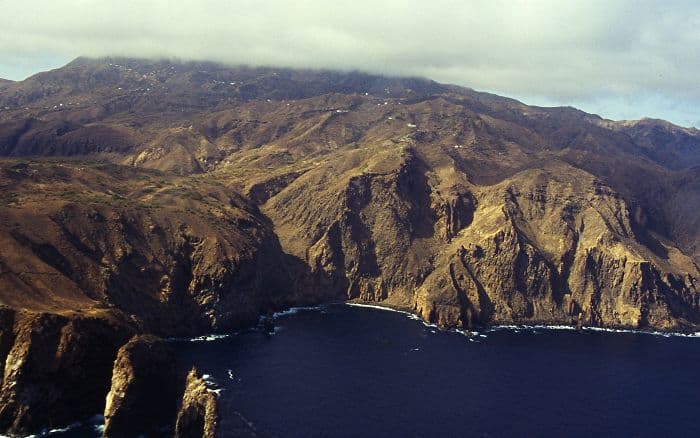
About Santo Antao
Santo Antao is a stratovolcano rising to 1,979 meters (6,493 feet) in Cabo Verde's Northern Africa Volcanic Regions. No historical eruptions have been recorded, though the volcano is classified based on geological evidence of past activity.
Geography & Climate
Santo Antao is located in Cabo Verde, within the Cape Verde Hotspot Volcano Group of the broader Northern Africa Volcanic Regions. Situated at 17.07° N, 25.17° W in the Northern Hemisphere, the volcano lies within a tropical climate zone. With a summit elevation of 1,979 meters above sea level, Santo Antao is a moderately sized peak that remains accessible to hikers and researchers for much of the year. The volcanic landform is characterized as a composite, which describes the physical shape and structure of the volcanic edifice as observed from the surface.
GVP Reference Summary
The 20 x 40 km dominantly volcanic island of Santo Antao is the NW-most of the Cape Verde Islands. Volcanic activity dates back to the Pliocene and continued into the late Pleistocene. A large 7-km-wide E-facing depression, Cha de Morte, was thought at one point to be a caldera, but was later interpreted as an erosional feature. Much of the island is covered by phonolitic pumice deposits of the Cao Grande Pumice, erupted about 200,000 years ago. The youngest eruptive products are lava flows that originated from vents at Cha de Lagoa in the central part of the island, just south of the NE-SW axial ridge. The lava flows cover an area of 40 km2 and reached the SE coast just SW of the coastal village of Porto Novo. These flows were initially considered by Mitchell-Thome (1976) to be Holocene in age based on morphological evidence, but later 40Ar/39Ar dating by Plesner et al. (2003) for these lava flows produced an age of 90,000 +/- 30,000 years.
— Smithsonian Institution, Global Volcanism Program
0 Recorded Eruptions
No eruption records available for Santo Antao.
Real-Time Data
Frequently Asked Questions About Santo Antao
Is Santo Antao an active volcano?+
Santo Antao is not currently classified as active. Its activity evidence is listed as "unknown." No recorded eruptions have been documented. However, no volcano is ever considered permanently extinct.
How high is Santo Antao?+
Santo Antao has a summit elevation of 1,979 meters (6,493 feet) above sea level. At 1,979 meters, it is a moderately sized volcanic peak, roughly comparable to Mount Vesuvius (1,281m).
What type of volcano is Santo Antao?+
Santo Antao is classified as a Stratovolcano. Stratovolcanoes (also called composite volcanoes) are steep, conical volcanoes built up by many layers of hardened lava, tephra, and volcanic ash. They are among the most common and dangerous types, known for explosive eruptions.
Where is Santo Antao located?+
Santo Antao is located in Cabo Verde, in the Northern Africa Volcanic Regions. More specifically, it lies within the Cape Verde Hotspot Volcano Group. Its exact coordinates are 17.070° latitude, -25.170° longitude.
Is it safe to visit Santo Antao?+
Santo Antao can generally be visited, but as with any volcano, visitors should check local conditions and any advisory notices before traveling. Cabo Verde may have specific regulations for accessing volcanic areas. Guided tours are often the safest and most informative way to experience a volcano.