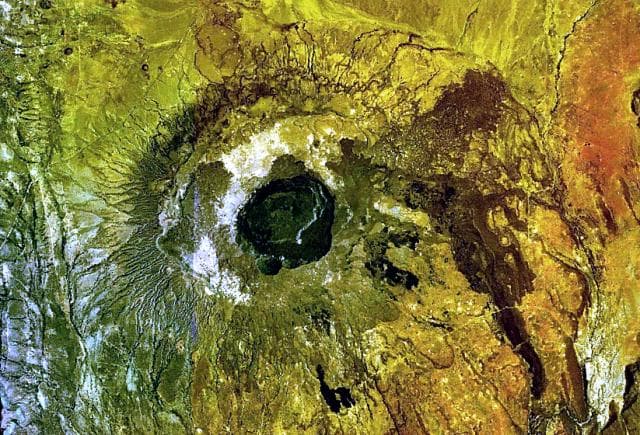
About Kilimanjaro
Kilimanjaro is a stratovolcano rising to 5,881 meters (19,296 feet) in Tanzania's Eastern Africa Volcanic Regions. No historical eruptions have been recorded, though the volcano is classified based on geological evidence of past activity.
Geography & Climate
Kilimanjaro is located in Tanzania, within the Kenyan Rift Volcanic Province of the broader Eastern Africa Volcanic Regions. Situated at 3.07° S, 37.35° E in the Southern Hemisphere, the volcano lies within a tropical climate zone. At 5,881 meters above sea level, Kilimanjaro reaches well into the permanent snow and ice zone. Glaciers and snowpack on the upper slopes create the potential for lahars — destructive volcanic mudflows — during eruptions, as heat rapidly melts ice and snow. The volcanic landform is characterized as a composite, which describes the physical shape and structure of the volcanic edifice as observed from the surface.
GVP Reference Summary
Massive Kilimanjaro consists of three overlapping edifices along a NW-SE trend, mostly constructed during the Pleistocene, with an ice-capped summit that reaches 5,200 m above the surrounding plains. Kibo is the central stratovolcano, which has a broad elongated profile and a 2 x 3 km summit caldera. Activity at the older Shira cone, which forms the broad WNW shoulder of the complex, began during the Pliocene. The extensively dissected Pleistocene Mawenzi forms a prominent, sharp-topped peak on the ESE flank, dominated by a densely packed radial dike swarm. More than 250 cones occupy a rift zone to the NW and SE. Fumarolic activity is present within a group of nested summit craters. Widespread statements that the "most recent activity was about 200 years ago," sometimes referencing the central "ash pit" formation, are of unknown origin with no supporting evidence in geological or anthropological literature. Nonnotte et al. (2008) K-Ar dated caldera-rim group lavas in the 170-274 ka range, and placed the most recent volcanism (formation of both the present summit crater, Inner Crater group lavas, and flank cones) around 150-200 ka. Martin-Jones et al. (2020) attributed two mafic tephra deposits in Lake Chala to Kilimanjaro that were dated to about 248 and 134 ka.
— Smithsonian Institution, Global Volcanism Program
0 Recorded Eruptions
No eruption records available for Kilimanjaro.
Real-Time Data
Frequently Asked Questions About Kilimanjaro
Is Kilimanjaro an active volcano?+
Kilimanjaro is not currently classified as active. Its activity evidence is listed as "unknown." No recorded eruptions have been documented. However, no volcano is ever considered permanently extinct.
How high is Kilimanjaro?+
Kilimanjaro has a summit elevation of 5,881 meters (19,296 feet) above sea level. At 5,881 meters, it stands taller than Mount Rainier (4,392m) and is among the world's major volcanic peaks.
What type of volcano is Kilimanjaro?+
Kilimanjaro is classified as a Stratovolcano. Stratovolcanoes (also called composite volcanoes) are steep, conical volcanoes built up by many layers of hardened lava, tephra, and volcanic ash. They are among the most common and dangerous types, known for explosive eruptions.
Where is Kilimanjaro located?+
Kilimanjaro is located in Tanzania, in the Eastern Africa Volcanic Regions. More specifically, it lies within the Kenyan Rift Volcanic Province. Its exact coordinates are -3.070° latitude, 37.350° longitude.
Is it safe to visit Kilimanjaro?+
Kilimanjaro can generally be visited, but as with any volcano, visitors should check local conditions and any advisory notices before traveling. Tanzania may have specific regulations for accessing volcanic areas. Guided tours are often the safest and most informative way to experience a volcano.