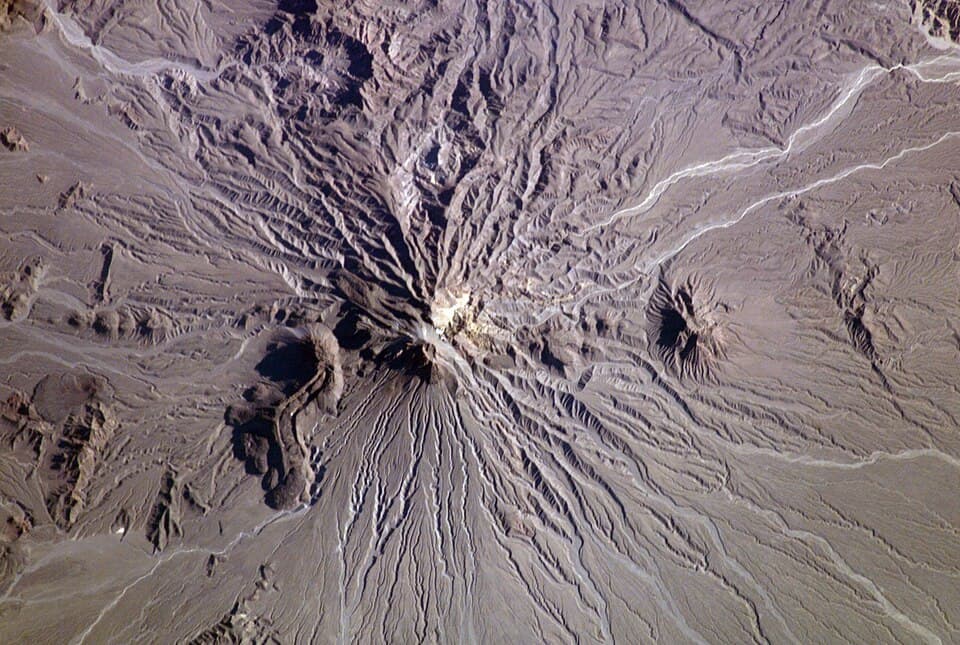
About Taftan
Taftan is a stratovolcano rising to 3,940 meters (12,927 feet) in Iran's Arabia-Central Asia Volcanic Regions. No historical eruptions have been recorded, though the volcano is classified based on geological evidence of past activity. The volcano has produced 2 recorded eruptions.
Geography & Climate
Taftan is located in Iran, within the Central Asia Volcanic Province of the broader Arabia-Central Asia Volcanic Regions. Situated at 28.60° N, 61.13° E in the Northern Hemisphere, the volcano lies within a subtropical climate zone. Standing at 3,940 meters above sea level, Taftan towers above the alpine zone, where vegetation gives way to bare rock, snow, and ice for much of the year. The high elevation means the upper slopes experience significantly colder temperatures than surrounding lowlands. The volcanic landform is characterized as a composite, which describes the physical shape and structure of the volcanic edifice as observed from the surface.
Eruption History Summary
Taftan has 2 recorded eruptions in the geological database, spanning from 1902 CE to 1993 CE. These eruptions span roughly 91 years of volcanic history. The most recent eruption in 1993 CE places this volcano within the modern era of volcanological observation.
GVP Reference Summary
Taftan is a strongly eroded andesitic stratovolcano with two prominent summits. The volcano was constructed along the Makran-Chagai Arc in SE Iran. The higher SE summit cone has been the source of lava flows, as well as of highly active, sulfur-encrusted fumaroles. In January 1902 the volcano was reported to be smoking heavily for several days, with occasional strong night-time glow. A lava flow was reported in 1993, but may have been a mistaken observation of a molten sulfur flow. Despite these reports there is no clear evidence for Holocene activity. The youngest date obtained by Pang et al. (2014), using U-Pb on a zircon, was about 800 ka. Biabangard and Moradian (2008) obtained K-Ar dates around 700 ka.
— Smithsonian Institution, Global Volcanism Program
2 Recorded Eruptions
| Year | VEI | Type | Area |
|---|---|---|---|
| 1993 | — | Uncertain Eruption | — |
| 1902 | — | Uncertain Eruption | — |
Real-Time Data
Frequently Asked Questions About Taftan
Is Taftan an active volcano?+
Taftan is not currently classified as active. Its activity evidence is listed as "unknown." No recorded eruptions have been documented. However, no volcano is ever considered permanently extinct.
When did Taftan last erupt?+
The most recent recorded eruption of Taftan occurred in 1993 CE. The eruption was classified as a "Uncertain Eruption." Taftan has 2 recorded eruptions in total.
How high is Taftan?+
Taftan has a summit elevation of 3,940 meters (12,927 feet) above sea level. At 3,940 meters, it is comparable in height to many significant mountain peaks and stands well above the tree line.
What type of volcano is Taftan?+
Taftan is classified as a Stratovolcano. Stratovolcanoes (also called composite volcanoes) are steep, conical volcanoes built up by many layers of hardened lava, tephra, and volcanic ash. They are among the most common and dangerous types, known for explosive eruptions.
Where is Taftan located?+
Taftan is located in Iran, in the Arabia-Central Asia Volcanic Regions. More specifically, it lies within the Central Asia Volcanic Province. Its exact coordinates are 28.600° latitude, 61.130° longitude.
Is it safe to visit Taftan?+
Taftan can generally be visited, but as with any volcano, visitors should check local conditions and any advisory notices before traveling. Iran may have specific regulations for accessing volcanic areas. Guided tours are often the safest and most informative way to experience a volcano.