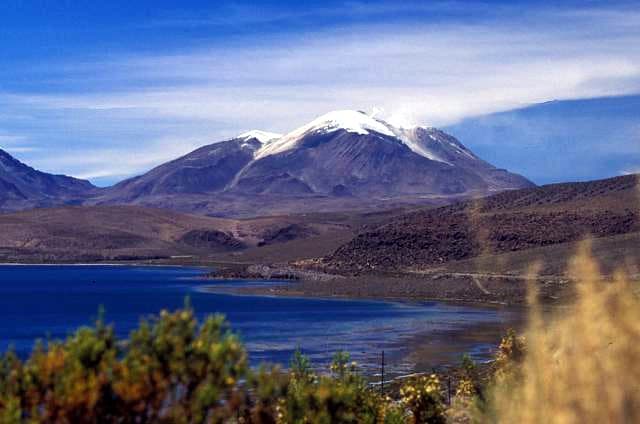
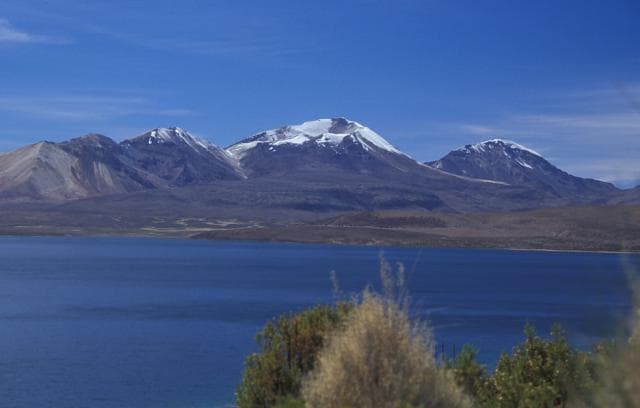
About Arintica
Arintica is a stratovolcano(es) rising to 5,597 meters (18,364 feet) in Chile's South America Volcanic Regions. No historical eruptions have been recorded, though the volcano is classified based on geological evidence of past activity.
Geography & Climate
Arintica is located in Chile, within the Central Andean Volcanic Arc of the broader South America Volcanic Regions. Situated at 18.75° S, 69.05° W in the Southern Hemisphere, the volcano lies within a tropical climate zone. At 5,597 meters above sea level, Arintica reaches well into the permanent snow and ice zone. Glaciers and snowpack on the upper slopes create the potential for lahars — destructive volcanic mudflows — during eruptions, as heat rapidly melts ice and snow. The volcanic landform is characterized as a composite, which describes the physical shape and structure of the volcanic edifice as observed from the surface.
GVP Reference Summary
Volcán Arintica is the central and most prominent cone of a large volcanic complex that rises north of the Salar de Surire. The complex includes Cerro Puquintica (also called Poquentica), 7 km to the east, Cerro Calajata, 3 km to the SW, and the dacitic Calajata lava dome at the SW end of the complex. The volcanoes are extensively dissected, but the latest activity at 5597-m-high Arintica produced a postglacial lava flow from a relatively well-preserved summit crater that descended the SE flank (de Silva and Francis, 1991). Later higher-resolution imagery indicated this lava flow was a collapse deposit and the volcano had a probable Pleistocene age (de Silva 2007, pers. comm.). Potassium-Argon ages of 637,000 and 486,000 yrs were obtained by Wörner et al. (2000), who suggested that based on the elevation and location of the volcano, the summit may not have been glaciated and that consequently the lack of glaciation may not denote Holocene activity. Cerro Puquintica (Poquentica) is considerably older than Arintica and rises to 5760 m.
— Smithsonian Institution, Global Volcanism Program
0 Recorded Eruptions
No eruption records available for Arintica.
Real-Time Data
Frequently Asked Questions About Arintica
Is Arintica an active volcano?+
Arintica is not currently classified as active. Its activity evidence is listed as "unknown." No recorded eruptions have been documented. However, no volcano is ever considered permanently extinct.
How high is Arintica?+
Arintica has a summit elevation of 5,597 meters (18,364 feet) above sea level. At 5,597 meters, it stands taller than Mount Rainier (4,392m) and is among the world's major volcanic peaks.
What type of volcano is Arintica?+
Arintica is classified as a Stratovolcano(es). Stratovolcano(es) volcanoes have distinct geological characteristics that set them apart from other volcanic types.
Where is Arintica located?+
Arintica is located in Chile, in the South America Volcanic Regions. More specifically, it lies within the Central Andean Volcanic Arc. Its exact coordinates are -18.750° latitude, -69.050° longitude.
Is it safe to visit Arintica?+
Arintica can generally be visited, but as with any volcano, visitors should check local conditions and any advisory notices before traveling. Chile may have specific regulations for accessing volcanic areas. Guided tours are often the safest and most informative way to experience a volcano.