About Jombolok
Jombolok is a volcanic field rising to 2,047 meters (6,716 feet) in Russia's Eastern Asia Volcanic Regions. Its last known eruption was in 737 CE. The volcano has produced 2 recorded eruptions.
Geography & Climate
Jombolok is located in Russia, within the Baikal Rift Volcanic Province of the broader Eastern Asia Volcanic Regions. Situated at 52.71° N, 99.02° E in the Northern Hemisphere, the volcano lies within a temperate climate zone. At 2,047 meters above sea level, Jombolok rises above the surrounding terrain into montane or subalpine conditions. The elevation creates distinct ecological zones along its flanks, from forested lower slopes to exposed rocky terrain near the summit. The volcanic landform is characterized as a minor (basaltic), which describes the physical shape and structure of the volcanic edifice as observed from the surface.
Geological Context
Jombolok is situated along a rift zone, where tectonic plates are pulling apart. As the crust thins and fractures, magma rises to fill the gap, creating volcanic activity. Rift volcanism typically produces more fluid lava flows rather than explosive blasts, which means communities near Jombolok in Russia generally face slower-moving hazards like lava flows and ground fissures rather than sudden pyroclastic events. However, rift volcanoes can still generate significant ash emissions and gas releases that affect local air quality. The dominant rock type is basalt / picro-basalt, a dark, fine-grained volcanic rock that forms from rapidly cooling, low-viscosity lava. Basaltic eruptions tend to be less explosive and produce fluid lava flows that can travel long distances. While less immediately dangerous than explosive eruptions, basaltic lava flows can destroy structures and infrastructure in their path, and volcanic gases released during these eruptions can affect air quality over a wide area.
Eruption History Summary
Jombolok has 2 recorded eruptions in the geological database, spanning from 5180 BCE to 737 CE. These eruptions span roughly 5,917 years of volcanic history.
GVP Reference Summary
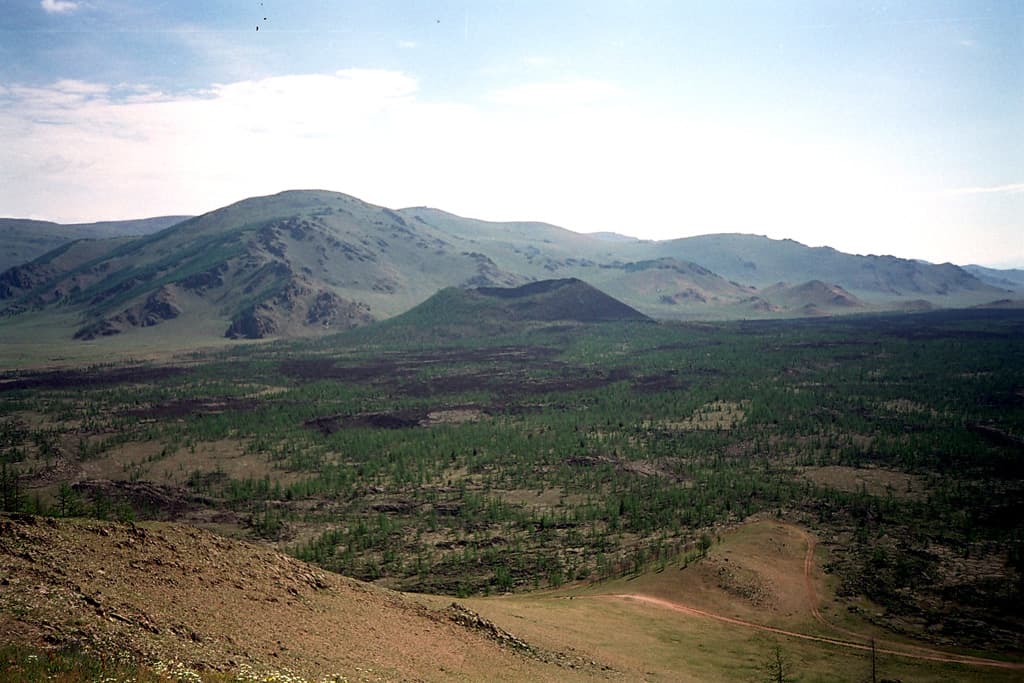
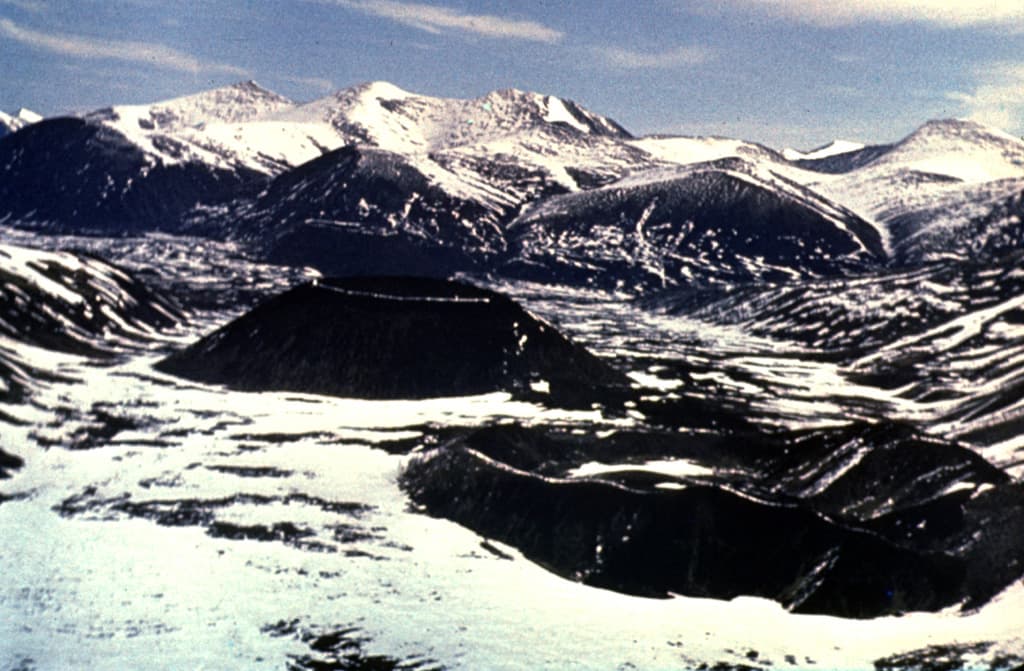
A group of small basaltic cinder cones in the East Sayan region of central Asia, about 200 km WNW of the SW tip of Lake Baikal, produced the Jombolok lava field. Six cones are located along a 5-km-long valley segment. Arzhannikov et al. (2016) defined four stages of activity that began about 13,000 years ago. The Stariy and Treshina cones formed during the first stage, followed by the Peretolchin, Atkinson, and Ostanets cones, which produced basaltic flows down the Jombolok and Oka river valleys to a distance of 75 km. A third stage formed the Kropotkin cone and erupted a smaller volume of lava that extended ~2.5 km NE to the Peretolchin cone along the upper reaches of the Khi-Gol and Kadyr-Os valleys. The fourth stage sent lava flows ~1.7 km SW in the upper Khi-Gol valley, transported through lava tubes from an uncertain source. Ivanov et al. (2011) reported calibrated 14C dates for flows from Atkinson to 5180 BCE. The youngest flows were dated by Arzhannikov et al. (2016) using a combination of 14C, dendrochronology, and historical research to 737 +/- 55 CE.
— Smithsonian Institution, Global Volcanism Program
2 Recorded Eruptions
| Year | VEI | Type | Area |
|---|---|---|---|
| 737 | — | Confirmed Eruption | Upper Khi-Gol valley |
| 5180 BCE | — | Confirmed Eruption | Atkinson cone |
Real-Time Data
Frequently Asked Questions About Jombolok
Is Jombolok an active volcano?+
Jombolok is not currently classified as active. Its activity evidence is listed as "Eruption Dated." The last known eruption was in 737 CE. However, no volcano is ever considered permanently extinct.
When did Jombolok last erupt?+
The most recent recorded eruption of Jombolok occurred in 737 CE. The eruption was classified as a "Confirmed Eruption." Jombolok has 2 recorded eruptions in total.
How high is Jombolok?+
Jombolok has a summit elevation of 2,047 meters (6,716 feet) above sea level. At 2,047 meters, it is comparable in height to many significant mountain peaks and stands well above the tree line.
What type of volcano is Jombolok?+
Jombolok is classified as a Volcanic field. Volcanic fields consist of clusters of small volcanic vents and cinder cones spread across a region. Rather than a single central vent, eruptions can occur at many points across the field.
Where is Jombolok located?+
Jombolok is located in Russia, in the Eastern Asia Volcanic Regions. More specifically, it lies within the Baikal Rift Volcanic Province. Its exact coordinates are 52.713° latitude, 99.021° longitude.
Is it safe to visit Jombolok?+
Jombolok can generally be visited, but as with any volcano, visitors should check local conditions and any advisory notices before traveling. Russia may have specific regulations for accessing volcanic areas. Guided tours are often the safest and most informative way to experience a volcano.