About Martin
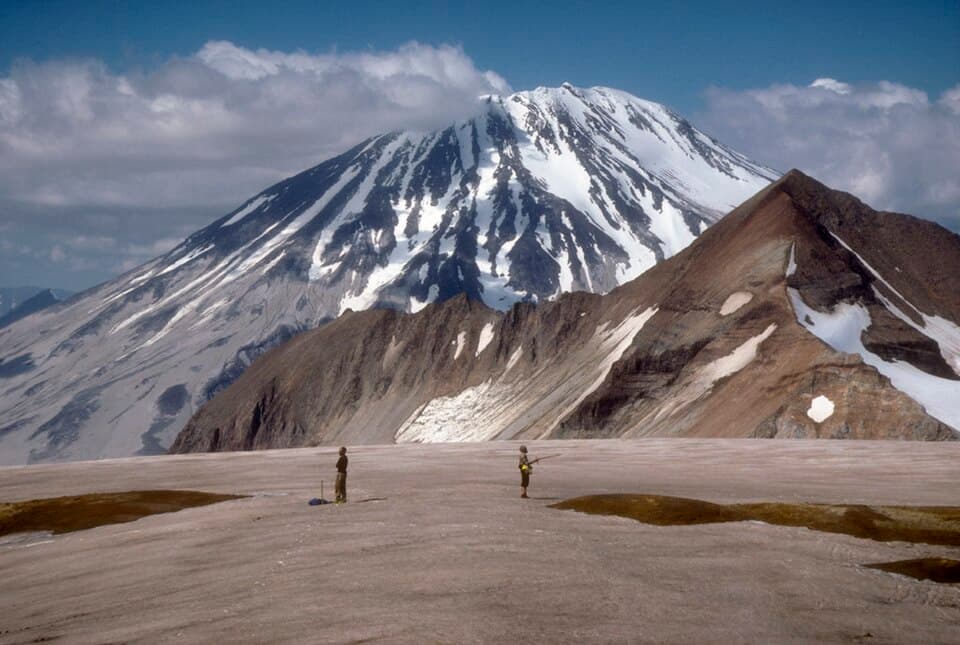
Martin is a stratovolcano rising to 1,863 meters (6,113 feet) in United States's North America Volcanic Regions. It last erupted in 1953 CE, and volcanologists consider it an active volcanic system. The volcano has produced 4 recorded eruptions.
Geography & Climate
Martin is located in United States, within the Alaska Peninsula Volcanic Arc of the broader North America Volcanic Regions. Situated at 58.17° N, 155.36° W in the Northern Hemisphere, the volcano lies within a subarctic climate zone. With a summit elevation of 1,863 meters above sea level, Martin is a moderately sized peak that remains accessible to hikers and researchers for much of the year. The volcanic landform is characterized as a composite, which describes the physical shape and structure of the volcanic edifice as observed from the surface.
Geological Context
Martin sits in a subduction zone, where one tectonic plate dives beneath another, creating intense heat and pressure that generates magma. Subduction zones are responsible for many of the world's most explosive volcanoes and deadliest eruptions. For communities in United States near Martin, this tectonic setting means the volcano is capable of producing powerful explosive eruptions, pyroclastic flows, and lahars that can threaten populated areas within tens of kilometers of the summit. The dominant rock type is dacite, an intermediate to silica-rich volcanic rock. This composition typically produces more viscous magma, leading to more explosive eruptions with ash columns and pyroclastic flows. Andesitic and dacitic magmas build pressure before erupting, which is why volcanoes with this rock chemistry are often associated with Plinian-style eruptions that can send ash tens of kilometers into the atmosphere and disrupt aviation across entire regions.
Eruption History Summary
Martin has 4 recorded eruptions in the geological database, spanning from 1750 BCE to 1953 CE. These eruptions span roughly 3,703 years of volcanic history. The most recent eruption in 1953 CE places this volcano within the modern era of volcanological observation.
GVP Reference Summary
The mostly ice-covered Mount Martin stratovolcano lies at the SW end of the Katmai volcano cluster in Katmai National Park. The volcano was named for George C. Martin, the first person to visit and describe the area after the 1912 eruption. It is capped by a 300-m-wide summit crater, which is ice-free because of an almost-constant steam plume; it also contains a shallow acidic lake. The edifice was constructed entirely during the Holocene, and overlies glaciated lava flows of the adjacent mid- to late-Pleistocene Alagoshak volcano to the WSW. Martin consists of a small fragmental cone that was the source of ten thick overlapping blocky dacitic lava flows, largely uneroded by glaciers, that descend 10 km to the NW, cover 31 km2, and form about 95% of the eruptive volume of the volcano. Two reports of historical eruptions that originated from uncertain sources were attributed by Muller et al. (1954) to Martin.
— Smithsonian Institution, Global Volcanism Program
4 Recorded Eruptions
| Year | VEI | Type | Area |
|---|---|---|---|
| 1953 | — | Confirmed Eruption | Volcano Uncertain: SW of Trident; probably Martin |
| 1951 | — | Confirmed Eruption | Volcano Uncertain: Kukak Bay ashfall; probably Martin |
| 800 BCE | — | Confirmed Eruption | — |
| 1750 BCE | — | Confirmed Eruption | — |
Real-Time Data
Frequently Asked Questions About Martin
Is Martin an active volcano?+
Martin is not currently classified as active. Its activity evidence is listed as "Eruption Dated." The last known eruption was in 1953 CE. However, no volcano is ever considered permanently extinct.
When did Martin last erupt?+
The most recent recorded eruption of Martin occurred in 1953 CE. The eruption was classified as a "Confirmed Eruption." Martin has 4 recorded eruptions in total.
How high is Martin?+
Martin has a summit elevation of 1,863 meters (6,113 feet) above sea level. At 1,863 meters, it is a moderately sized volcanic peak, roughly comparable to Mount Vesuvius (1,281m).
What type of volcano is Martin?+
Martin is classified as a Stratovolcano. Stratovolcanoes (also called composite volcanoes) are steep, conical volcanoes built up by many layers of hardened lava, tephra, and volcanic ash. They are among the most common and dangerous types, known for explosive eruptions.
Where is Martin located?+
Martin is located in United States, in the North America Volcanic Regions. More specifically, it lies within the Alaska Peninsula Volcanic Arc. Its exact coordinates are 58.172° latitude, -155.361° longitude.
Is it safe to visit Martin?+
Martin can generally be visited, but as with any volcano, visitors should check local conditions and any advisory notices before traveling. United States may have specific regulations for accessing volcanic areas. Guided tours are often the safest and most informative way to experience a volcano.