Changbaishan
Stratovolcano · 2,744m · China-North Korea
About Changbaishan
Changbaishan is a stratovolcano rising to 2,744 meters (9,003 feet) in China-North Korea's Eastern Asia Volcanic Regions. It last erupted in 1903 CE, and volcanologists consider it an active volcanic system. The volcano has produced 10 recorded eruptions, with a maximum Volcanic Explosivity Index (VEI) of 6.
Geography & Climate
Changbaishan is located in China-North Korea, within the Central East Asia Volcanic Province of the broader Eastern Asia Volcanic Regions. Situated at 41.98° N, 128.08° E in the Northern Hemisphere, the volcano lies within a temperate climate zone. At 2,744 meters above sea level, Changbaishan rises above the surrounding terrain into montane or subalpine conditions. The elevation creates distinct ecological zones along its flanks, from forested lower slopes to exposed rocky terrain near the summit. The volcanic landform is characterized as a composite, which describes the physical shape and structure of the volcanic edifice as observed from the surface.
Geological Context
Changbaishan is an intraplate volcano, meaning it formed away from any plate boundary. These volcanoes are often powered by hotspots — plumes of abnormally hot mantle material rising from deep within the Earth. Hotspot volcanoes like Changbaishan tend to produce effusive eruptions with lava flows that can be relatively predictable, giving nearby communities in China-North Korea more time to prepare. However, they can also produce explosive phases, particularly when magma interacts with groundwater. The dominant rock type is trachyte / trachydacite, an intermediate to silica-rich volcanic rock. This composition typically produces more viscous magma, leading to more explosive eruptions with ash columns and pyroclastic flows. Andesitic and dacitic magmas build pressure before erupting, which is why volcanoes with this rock chemistry are often associated with Plinian-style eruptions that can send ash tens of kilometers into the atmosphere and disrupt aviation across entire regions.
Eruption History Summary
Changbaishan has 10 recorded eruptions in the geological database, spanning from 2155 BCE to 1903 CE. The most powerful recorded event was a colossal eruption capable of affecting global climate for years in 946 CE, reaching VEI 6 on the Volcanic Explosivity Index. Notable eruptions include 946 CE (VEI 6), 180 BCE (VEI 4), 2155 BCE (VEI 4). This level of eruptive frequency indicates a persistently active volcanic system that warrants ongoing monitoring. The most recent eruption in 1903 CE places this volcano within the modern era of volcanological observation.
Significance
Changbaishan has produced at least one eruption of VEI 6 or higher, placing it among the most powerful volcanic systems on Earth. Eruptions of this magnitude inject massive quantities of sulfur dioxide into the stratosphere, affecting global climate by lowering average temperatures for one to three years after the event. With 10 recorded eruptions, Changbaishan has a substantial eruptive history that provides valuable data for understanding volcanic behavior and assessing future hazards in the Eastern Asia Volcanic Regions region.
GVP Reference Summary
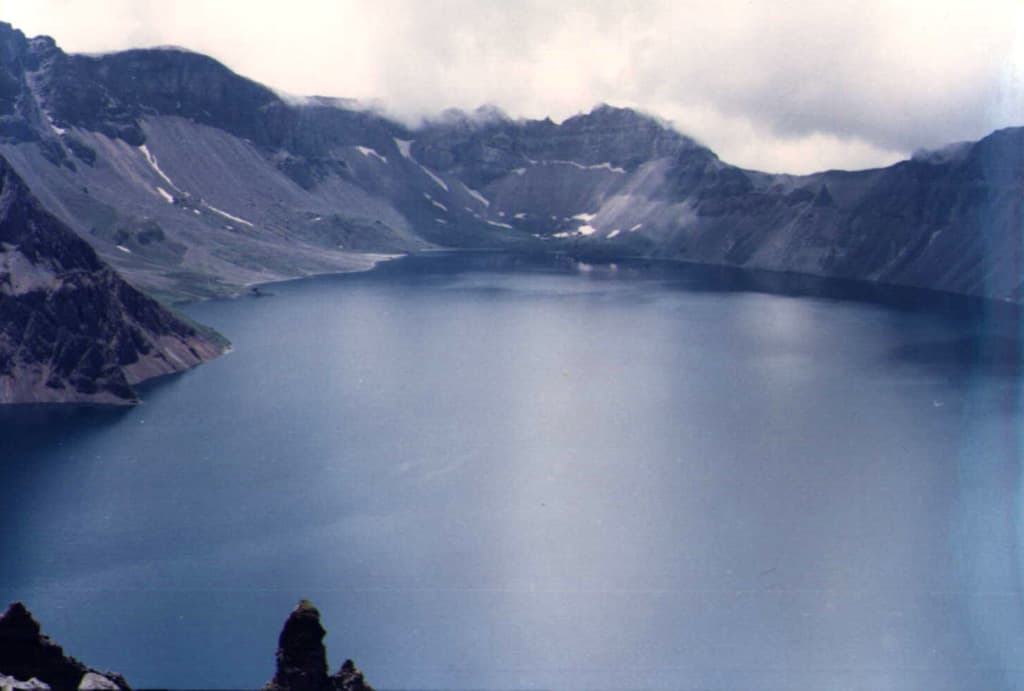
Massive Changbaishan stratovolcano (also known as Baitoushan and by the Korean names of Baegdu, Paektu, or P'aektu-san), is located along the China/Korea border. A 5-km-wide, 850-m-deep summit caldera is filled by Lake Tianchi (Sky Lake). The 60-km-diameter dominantly trachytic and rhyolitic volcano was constructed over the Changbaishan (Laoheidingzi) shield volcano. Satellitic cinder cones are aligned along a NNE trend. One of the largest known Holocene explosive eruptions took place here about 946 CE, depositing tephra as far away as northern Japan and forming in part the present caldera; Yang et al. (2021) estimated the total erupted volume to be 40-98 km3. Minor eruptions have been recorded since the 15th century.
— Smithsonian Institution, Global Volcanism Program
10 Recorded Eruptions
How Changbaishan's 4 size-rated eruptions break down by Volcanic Explosivity Index. Select a bar to see what that size means.
Cataclysmic — ash columns of 10–25 km reaching the stratosphere.
Of Changbaishan's 4 size-rated eruptions on record, the most common was VEI 4 (2 of 4, 50%). Most of its rated eruptions were large (VEI 4+), a violent-end size profile. The largest on record reached VEI 6.
Based on the Smithsonian GVP eruption record. This describes Changbaishan's past eruptions only — it does not predict future activity. What is the VEI? · Most explosive volcanoes
| Year | VEI | Type | Area |
|---|---|---|---|
| 1903 | — | Confirmed Eruption | Liuhaojie tuff ring? |
| 1898 | 2 | Confirmed Eruption | — |
| 1702 | — | Confirmed Eruption | — |
| 1668 | — | Confirmed Eruption | — |
| 1597 | — | Uncertain Eruption | — |
| 1413 | — | Uncertain Eruption | — |
| 946 | 6 | Confirmed Eruption | Millennium Eruption |
| 180 BCE | 4 | Confirmed Eruption | — |
| 1000 BCE | — | Uncertain Eruption | — |
| 2155 BCE | 4 | Confirmed Eruption | — |
Real-Time Data
Frequently Asked Questions About Changbaishan
Is Changbaishan an active volcano?+
Yes, Changbaishan is considered an active volcano. Its most recent eruption was in 1903 CE. The volcano is monitored by geological agencies, and its activity status is based on observed eruptions within recorded history.
When did Changbaishan last erupt?+
The most recent recorded eruption of Changbaishan occurred in 1903 CE. The eruption was classified as a "Confirmed Eruption." Changbaishan has 10 recorded eruptions in total.
How high is Changbaishan?+
Changbaishan has a summit elevation of 2,744 meters (9,003 feet) above sea level. At 2,744 meters, it is comparable in height to many significant mountain peaks and stands well above the tree line.
What type of volcano is Changbaishan?+
Changbaishan is classified as a Stratovolcano. Stratovolcanoes (also called composite volcanoes) are steep, conical volcanoes built up by many layers of hardened lava, tephra, and volcanic ash. They are among the most common and dangerous types, known for explosive eruptions.
Where is Changbaishan located?+
Changbaishan is located in China-North Korea, in the Eastern Asia Volcanic Regions. More specifically, it lies within the Central East Asia Volcanic Province. Its exact coordinates are 41.980° latitude, 128.080° longitude.
Is it safe to visit Changbaishan?+
Visiting Changbaishan requires checking current volcanic activity and alert levels. As an active volcano with eruptions as recent as 1903 CE, conditions can change rapidly. Always consult local geological authorities and follow official warnings before visiting. Many active volcanoes have designated safe viewing areas and guided tour options.