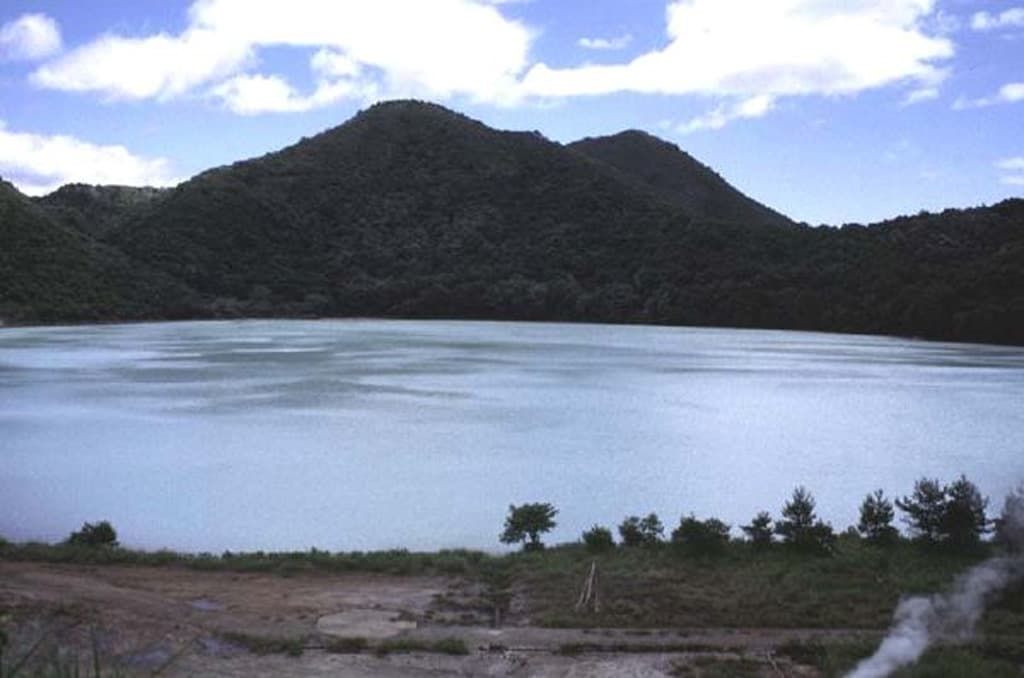
About Naruko
Naruko is a caldera rising to 470 meters (1,542 feet) in Japan's Northwestern Pacific Volcanic Regions. Its last known eruption was in 837 CE. The volcano has produced 5 recorded eruptions, with a maximum Volcanic Explosivity Index (VEI) of 1.
Geography & Climate
Naruko is located in Japan, within the Northeast Japan Volcanic Arc of the broader Northwestern Pacific Volcanic Regions. Situated at 38.73° N, 140.73° E in the Northern Hemisphere, the volcano lies within a temperate climate zone. At just 470 meters above sea level, Naruko is a relatively low-elevation volcanic feature. Despite its modest height, it remains an active geological formation with the same underlying magmatic processes as its taller counterparts. The volcanic landform is characterized as a cluster, which describes the physical shape and structure of the volcanic edifice as observed from the surface.
Geological Context
Naruko sits in a subduction zone, where one tectonic plate dives beneath another, creating intense heat and pressure that generates magma. Subduction zones are responsible for many of the world's most explosive volcanoes and deadliest eruptions. For communities in Japan near Naruko, this tectonic setting means the volcano is capable of producing powerful explosive eruptions, pyroclastic flows, and lahars that can threaten populated areas within tens of kilometers of the summit. The dominant rock type is rhyolite, a silica-rich volcanic rock associated with highly viscous magma. Rhyolitic eruptions can be extremely explosive and are responsible for some of the largest volcanic events in Earth's history, including supervolcanic caldera-forming eruptions. The high silica content traps dissolved gases, building enormous pressure that can lead to catastrophic explosive releases.
Eruption History Summary
Naruko has 5 recorded eruptions in the geological database, spanning from 4400 BCE to 837 CE. The most powerful recorded event was a gentle, effusive event in 837 CE, reaching VEI 1 on the Volcanic Explosivity Index. This eruption frequency indicates a moderately active volcanic system with periodic reawakenings.
Significance
With 5 recorded eruptions on file, Naruko has enough documented activity to help scientists identify patterns in its eruptive behavior.
GVP Reference Summary
Naruko is a poorly defined, 5.5 x 7 km caldera NW of the city of Sendai. Formed during eruptions about 73,000 and 45,000 years ago, it contains a cluster of four dacitic lava domes of Holocene age surrounding the 400-m-wide lake-filled Katanuma crater. The highest of the low, but steep-sided lava domes, Ogadake, lies SE of the lake and reaches only 470 m above sea level. Ogadake and Kurumigadake domes are capped by conglomerates and mudstones uplifted during dome growth. The only recorded eruption in occurred in 837 CE. Water vapor and sulfur-dioxide gas emission occurs from Shurado crater on Toyagamori lava dome west of the lake and from the bottom of the crater lake, which is one of the most acidic in Japan, with a pH of 1.6. Solfataras are found on the western shore of Katanuma, and sulfur is mined from sediments on the lake floor.
— Smithsonian Institution, Global Volcanism Program
5 Recorded Eruptions
| Year | VEI | Type | Area |
|---|---|---|---|
| 837 | 1 | Confirmed Eruption | — |
| 800 BCE | — | Confirmed Eruption | — |
| 1350 BCE | — | Confirmed Eruption | — |
| 1400 BCE | — | Confirmed Eruption | — |
| 4400 BCE | — | Confirmed Eruption | — |
Real-Time Data
Frequently Asked Questions About Naruko
Is Naruko an active volcano?+
Naruko is classified as active based on credible evidence of past eruptions. Although its last known eruption was in 837 CE, volcanologists consider it capable of erupting again.
When did Naruko last erupt?+
The most recent recorded eruption of Naruko occurred in 837 CE with a Volcanic Explosivity Index (VEI) of 1. The eruption was classified as a "Confirmed Eruption." Naruko has 5 recorded eruptions in total.
How high is Naruko?+
Naruko has a summit elevation of 470 meters (1,542 feet) above sea level. At 470 meters, it is a relatively low-elevation volcano.
What type of volcano is Naruko?+
Naruko is classified as a Caldera. Calderas are large volcanic depressions formed when a volcano erupts so powerfully that its magma chamber collapses, creating a basin that can be kilometers wide. They are often sites of some of Earth's largest eruptions.
Where is Naruko located?+
Naruko is located in Japan, in the Northwestern Pacific Volcanic Regions. More specifically, it lies within the Northeast Japan Volcanic Arc. Its exact coordinates are 38.729° latitude, 140.734° longitude.
Is it safe to visit Naruko?+
Naruko can generally be visited, but as with any volcano, visitors should check local conditions and any advisory notices before traveling. Japan may have specific regulations for accessing volcanic areas. Guided tours are often the safest and most informative way to experience a volcano.


![Zaozan [Zaosan]](/_next/image?url=https%3A%2F%2Fvolcano.si.edu%2Fgallery%2Fphotos%2FGVP-10588.jpg&w=1600&q=75)