About Macdonald
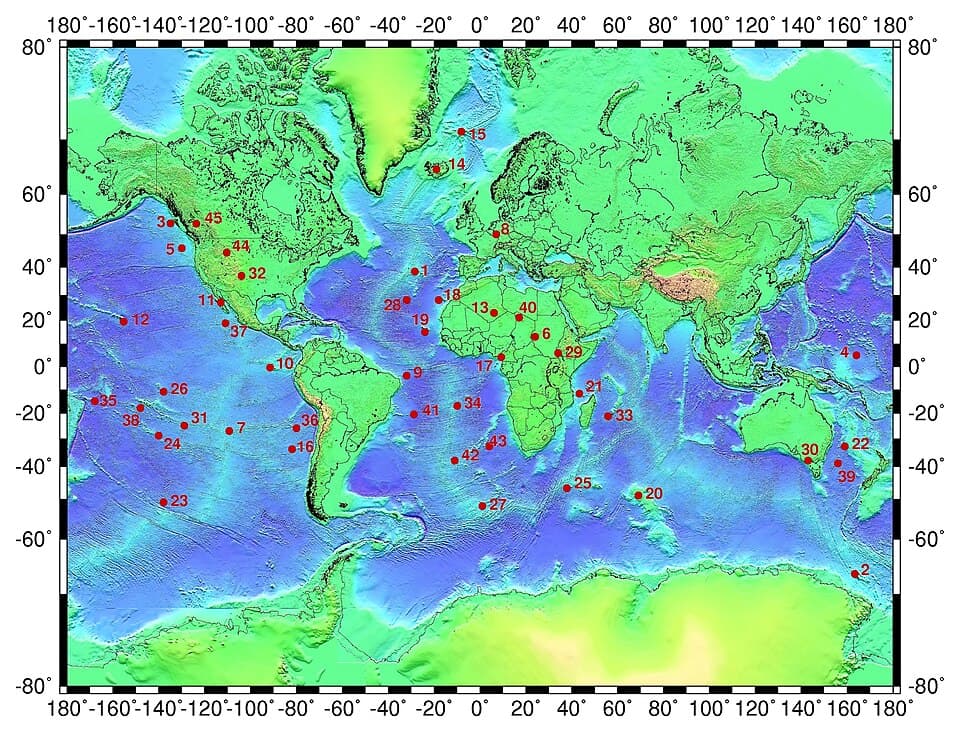
Macdonald is a shield rising to -39 meters (-128 feet) in France's Southern Pacific Volcanic Regions. It last erupted in 1989 CE, and volcanologists consider it an active volcanic system. The volcano has produced 12 recorded eruptions.
Geography & Climate
Macdonald is located in France, within the Austral-Cook Hotspot Volcano Group of the broader Southern Pacific Volcanic Regions. Situated at 28.98° S, 140.25° W in the Southern Hemisphere, the volcano lies within a subtropical climate zone. With an elevation of -39 meters — below sea level — Macdonald is a submarine or submerged volcanic feature. Submarine volcanoes make up the majority of Earth's volcanic activity, though most eruptions go unobserved beneath the ocean surface. The volcanic landform is characterized as a shield, which describes the physical shape and structure of the volcanic edifice as observed from the surface.
Geological Context
Macdonald is an intraplate volcano, meaning it formed away from any plate boundary. These volcanoes are often powered by hotspots — plumes of abnormally hot mantle material rising from deep within the Earth. Hotspot volcanoes like Macdonald tend to produce effusive eruptions with lava flows that can be relatively predictable, giving nearby communities in France more time to prepare. However, they can also produce explosive phases, particularly when magma interacts with groundwater. The dominant rock type is basalt / picro-basalt, a dark, fine-grained volcanic rock that forms from rapidly cooling, low-viscosity lava. Basaltic eruptions tend to be less explosive and produce fluid lava flows that can travel long distances. While less immediately dangerous than explosive eruptions, basaltic lava flows can destroy structures and infrastructure in their path, and volcanic gases released during these eruptions can affect air quality over a wide area.
Eruption History Summary
Macdonald has 12 recorded eruptions in the geological database, spanning from 1928 CE to 1989 CE. This level of eruptive frequency indicates a persistently active volcanic system that warrants ongoing monitoring. The most recent eruption in 1989 CE places this volcano within the modern era of volcanological observation.
Significance
With 12 recorded eruptions, Macdonald has a substantial eruptive history that provides valuable data for understanding volcanic behavior and assessing future hazards in the Southern Pacific Volcanic Regions region. Given its recent activity, Macdonald is closely monitored by geological survey organizations to provide early warning of future unrest.
GVP Reference Summary
Discovered by the detection of teleseismic waves in 1967, Macdonald seamount (also known as Tamarii seamount) rises from a depth of about 1,800 m to within 27 m of the ocean surface at the eastern end of the Austral Islands. The basaltic submarine volcano marks the site of a hotspot that was the source of the Austral-Cook island chain. The summit, named after volcanologist Gordon Macdonald, consists of a flat plateau about 100 x 150 m wide with an average depth of about 40 m. The summit plateau is capped with spatter cones that form steep-sided pinnacles. Most eruptions have been seismically detected, but in 1987 and 1989 pumice emission was observed from research vessels. Pumice rafts observed in the South Pacific in 1928 and 1936 may also have originated here.
— Smithsonian Institution, Global Volcanism Program
12 Recorded Eruptions
How Macdonald's 12 size-rated eruptions break down by Volcanic Explosivity Index. Select a bar to see what that size means.
Effusive — gentle lava flows with little to no explosion.
Of Macdonald's 12 size-rated eruptions on record, the most common was VEI 0 (12 of 12, 100%). It is overwhelmingly effusive, erupting gently at nearly the same small size again and again — classic shield-building behaviour. No eruption on record exceeded VEI 0.
Based on the Smithsonian GVP eruption record. This describes Macdonald's past eruptions only — it does not predict future activity. What is the VEI? · Most explosive volcanoes
| Year | VEI | Type | Area |
|---|---|---|---|
| 1987 – 1989 | 0 | Confirmed Eruption | — |
| 1986 | 0 | Confirmed Eruption | — |
| 1983 | 0 | Confirmed Eruption | — |
| 1983 – 1984 | 0 | Confirmed Eruption | — |
| 1982 | 0 | Confirmed Eruption | — |
| 1980 | 0 | Confirmed Eruption | — |
| 1980 – 1981 | 0 | Confirmed Eruption | — |
| 1979 | 0 | Confirmed Eruption | — |
| 1977 | 0 | Confirmed Eruption | — |
| 1967 | 0 | Confirmed Eruption | — |
| 1936 | 0 | Uncertain Eruption | Volcano Uncertain: pumice rafts in South Pacific |
| 1928 | 0 | Uncertain Eruption | Volcano Uncertain: pumice rafts in South Pacific |
Real-Time Data
Frequently Asked Questions About Macdonald
Is Macdonald an active volcano?+
Yes, Macdonald is considered an active volcano. Its most recent eruption was in 1989 CE. The volcano is monitored by geological agencies, and its activity status is based on observed eruptions within recorded history.
When did Macdonald last erupt?+
The most recent recorded eruption of Macdonald began in 1987 CE and continued until 1989 CE with a Volcanic Explosivity Index (VEI) of 0. The eruption was classified as a "Confirmed Eruption." Macdonald has 12 recorded eruptions in total.
How high is Macdonald?+
Macdonald has a summit elevation of -39 meters (-128 feet) above sea level. With an elevation of -39 meters (below sea level), this is a submarine or submerged volcanic feature.
What type of volcano is Macdonald?+
Macdonald is classified as a Shield. Shield volcanoes have distinct geological characteristics that set them apart from other volcanic types.
Where is Macdonald located?+
Macdonald is located in France, in the Southern Pacific Volcanic Regions. More specifically, it lies within the Austral-Cook Hotspot Volcano Group. Its exact coordinates are -28.980° latitude, -140.250° longitude.
Is it safe to visit Macdonald?+
Visiting Macdonald requires checking current volcanic activity and alert levels. As an active volcano with eruptions as recent as 1989 CE, conditions can change rapidly. Always consult local geological authorities and follow official warnings before visiting. Many active volcanoes have designated safe viewing areas and guided tour options.

