Interactive Tool

Compare Volcanoes Side by Side

Line up any 2–4 of the world's 1,740 volcanoesand see how they differ on type, height, eruption history and explosive power. Every figure is drawn straight from the Smithsonian Global Volcanism Program record — no estimates, no forecasts. You're comparing Krakatau, Tambora below; change either side to compare any volcanoes you like.

Pick 2–4 volcanoes to compare side by side. Your selection is saved in the page URL, so you can bookmark or share the exact comparison.

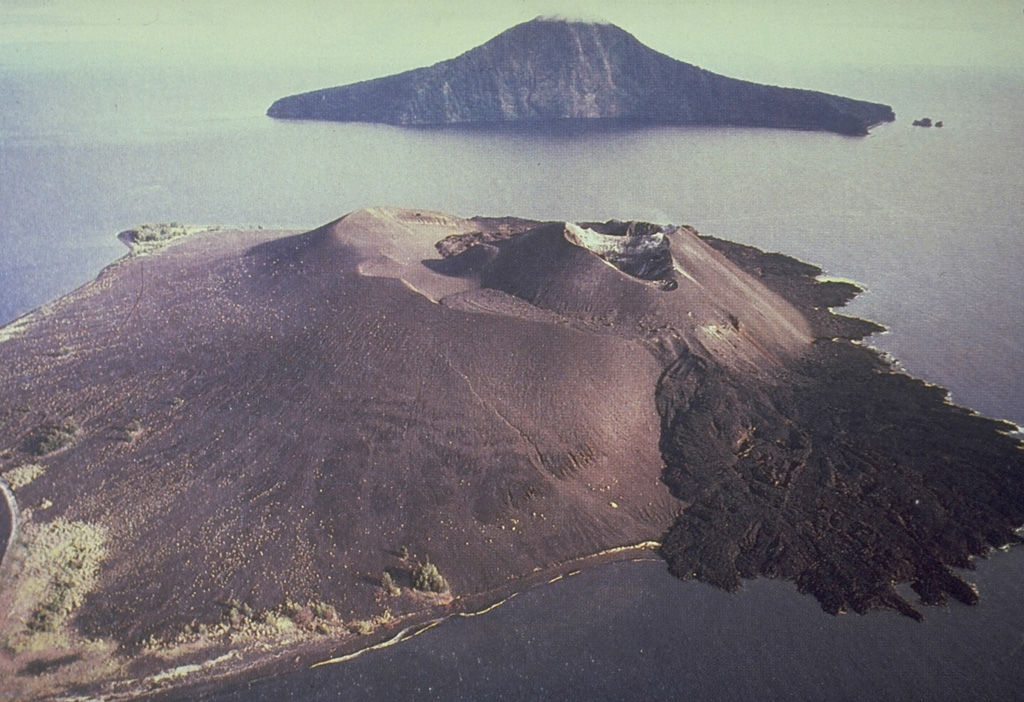
Krakatau volcano in Indonesia
Krakatau

Indonesia·Caldera

The renowned Krakatau (frequently mis-named as Krakatoa) volcano lies in the Sunda Strait between Java and Sumatra. Collapse of an older edifice, perhaps in 416 or 535 CE, formed a 7-km-wide caldera. Remnants of that volcano are preserved in Verlaten and Lang Islands; subsequently the Rakata, Danan, and Perbuwatan cones were formed, coalescing to create the pre-1883 Krakatau Island. Caldera collapse during the catastrophic 1883 eruption destroyed Danan and Perbuwatan, and left only a remnant of Rakata. This eruption caused more than 36,000 fatalities, most as a result of tsunamis that swept the adjacent coastlines of Sumatra and Java. Pyroclastic surges traveled 40 km across the Sunda Strait and reached the Sumatra coast. After a quiescence of less than a half century, the post-collapse cone of Anak Krakatau (Child of Krakatau) was constructed within the 1883 caldera at a point between the former Danan and Perbuwatan cones. Anak Krakatau has been the site of frequent eruptions since 1927.

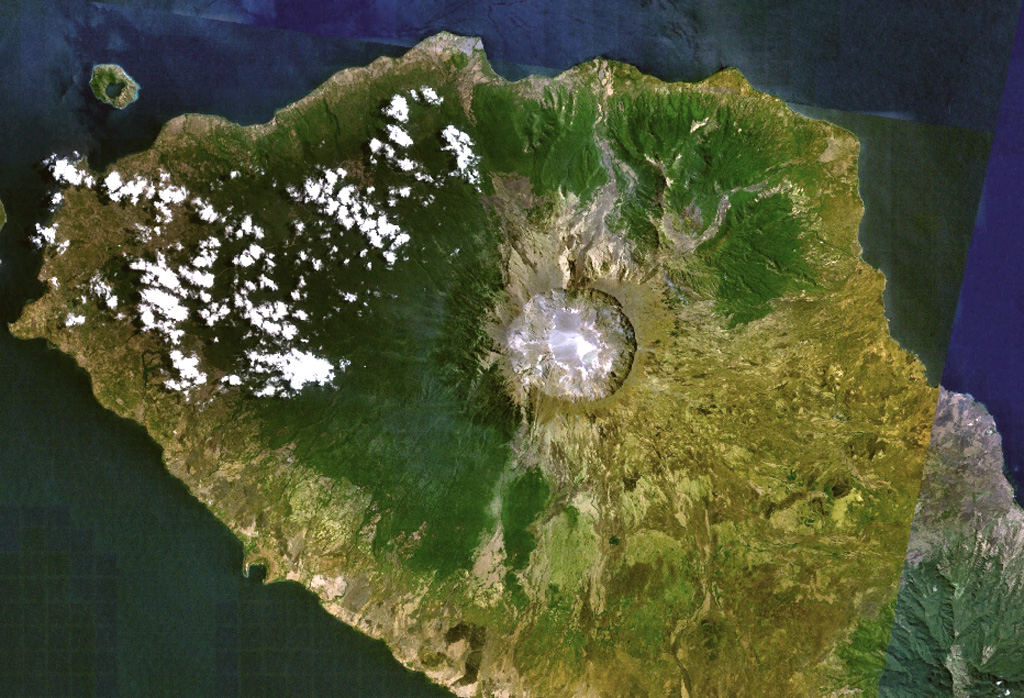
Tambora volcano in Indonesia
Tambora

Indonesia·Stratovolcano

The massive Tambora stratovolcano forms the entire 60-km-wide Sanggar Peninsula on northern Sumbawa Island. The largely trachybasaltic-to-trachyandesitic volcano grew to about 4,000 m elevation before forming a caldera more than 43,000 years ago. Late-Pleistocene lava flows largely filled the early caldera, after which activity changed to dominantly explosive eruptions during the early Holocene. Tambora was the source of history's largest explosive eruption, in April 1815. Pyroclastic flows reached the sea on all sides of the peninsula, and heavy tephra fall devastated croplands, causing an estimated 60,000 fatalities. The eruption of an estimated more than 150 km3 of tephra formed a 6-km-wide, 1250-m-deep caldera and produced global climatic effects. Minor lava domes and flows have been extruded on the caldera floor at Tambora during the 19th and 20th centuries.

MetricKrakatauTambora
TypeCalderaStratovolcano
LocationIndonesia · Sunda-Banda Volcanic RegionsIndonesia · Sunda-Banda Volcanic Regions
Summit elevation285 m · 935 ft2,850 m · 9,350 ft
Tectonic settingSubduction zone / Continental crust (> 25 km)Subduction zone / Continental crust (> 25 km)
Dominant rockAndesite / Basaltic AndesiteTrachybasalt / Tephrite Basanite
Recorded eruptions587
Largest recorded eruptionVEI 6VEI 7
Large (VEI 4+) eruptions21
Eruption record spans250 CE – 2,021 CE3,910 BCE – 1,967 CE
Last known eruption2023 CE1967 CE
Coordinates-6.10, 105.42-8.25, 118.00
Explore

Highlighted values mark the leading volcano on that row. Elevation, type and location are from the Smithsonian GVP volcano record; eruption counts and VEI figures are computed from that volcano's full eruption list. Figures describe the recorded past only and do not forecast future activity. Tour links are affiliate links.

Height at a glance

Krakatau285 m
Tambora2,850 m

How their eruptions compare in size

Each volcano's Volcanic Explosivity Index “fingerprint” shows how its recorded eruptions break down by size. Two volcanoes can have erupted a similar number of times yet have completely different fingerprints — one dribbling lava, the other capable of rare, violent blasts.

Krakatau

Eruption-Size Fingerprint

How Krakatau's 51 size-rated eruptions break down by Volcanic Explosivity Index. Select a bar to see what that size means.

Volcanic Explosivity Index (VEI)
232 eruptions (63%)

Explosive — ash plumes reaching 1–5 km, localized impact.

Of Krakatau's 51 size-rated eruptions on record, the most common was VEI 2 (32 of 51, 63%). It is strikingly consistent, erupting at close to the same size again and again. The largest on record reached VEI 6.

Based on the Smithsonian GVP eruption record. This describes Krakatau's past eruptions only — it does not predict future activity. What is the VEI? · Most explosive volcanoes

Tambora

Eruption-Size Fingerprint

How Tambora's 4 size-rated eruptions break down by Volcanic Explosivity Index. Select a bar to see what that size means.

Volcanic Explosivity Index (VEI)
22 eruptions (50%)

Explosive — ash plumes reaching 1–5 km, localized impact.

Of Tambora's 4 size-rated eruptions on record, the most common was VEI 2 (2 of 4, 50%). Its record is centred on moderate explosive eruptions (VEI 2–3), with larger events far rarer. The largest on record reached VEI 7.

Based on the Smithsonian GVP eruption record. This describes Tambora's past eruptions only — it does not predict future activity. What is the VEI? · Most explosive volcanoes

Popular comparisons

How to compare volcanoes

No single number makes one volcano “bigger” or “more dangerous” than another — it depends on what you measure. A broad shield volcano like Mauna Loa dwarfs most peaks by volume yet erupts gently, while a steep stratovolcano like Vesuvius is far smaller but erupts explosively. This tool puts the meaningful metrics side by side — type, summit elevation, how many eruptions are on record, the largest size reached on the Volcanic Explosivity Index, and the most recent known eruption — so the contrast is obvious at a glance.

Reading the rows together tells the real story. A high eruption count with a low peak VEI is the signature of a frequently-active but gentle volcano; a low count with a high peak VEI marks one that erupts rarely but catastrophically. To see which volcanoes have the largest explosive records overall, browse the most explosive volcanoes ranking, or watch what is happening now on the active volcanoes tracker.

Continue exploring