Interactive Tool

Compare Volcanoes Side by Side

Line up any 2–4 of the world's 1,740 volcanoesand see how they differ on type, height, eruption history and explosive power. Every figure is drawn straight from the Smithsonian Global Volcanism Program record — no estimates, no forecasts. You're comparing Rainier, St. Helens below; change either side to compare any volcanoes you like.

Pick 2–4 volcanoes to compare side by side. Your selection is saved in the page URL, so you can bookmark or share the exact comparison.

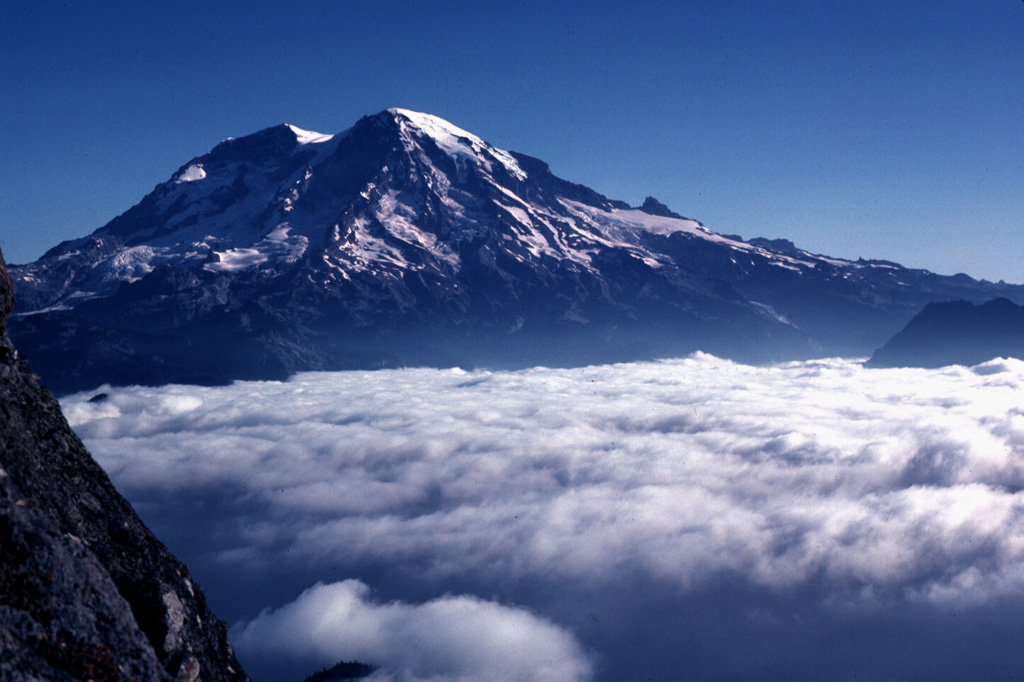
Rainier volcano in United States
Rainier

United States·Stratovolcano

Mount Rainier is a heavily glaciated andesitic volcano in the Puget Sound region. Large Holocene mudflows from collapse have reached as far as the Puget Sound lowlands. The present summit was constructed within a large crater breached to the NE, formed by collapse during a major explosive eruption about 5,600 years ago that deposited the widespread Osceola Mudflow. Rainier has produced eruptions throughout the Holocene, including about a dozen during the past 2,600 years; the largest of these occurred about 2,200 years ago. The present summit cone is capped by two overlapping craters. Extensive hydrothermal alteration of the upper portion of the volcano has contributed to its structural weakness; an active thermal system has caused periodic melting on flank glaciers and produced an elaborate system of steam caves in the summit icecap. Reported uncertain 19th-century eruptions, including a possible but not confirmed phreatic eruption in 1894, have not left identifiable deposits.

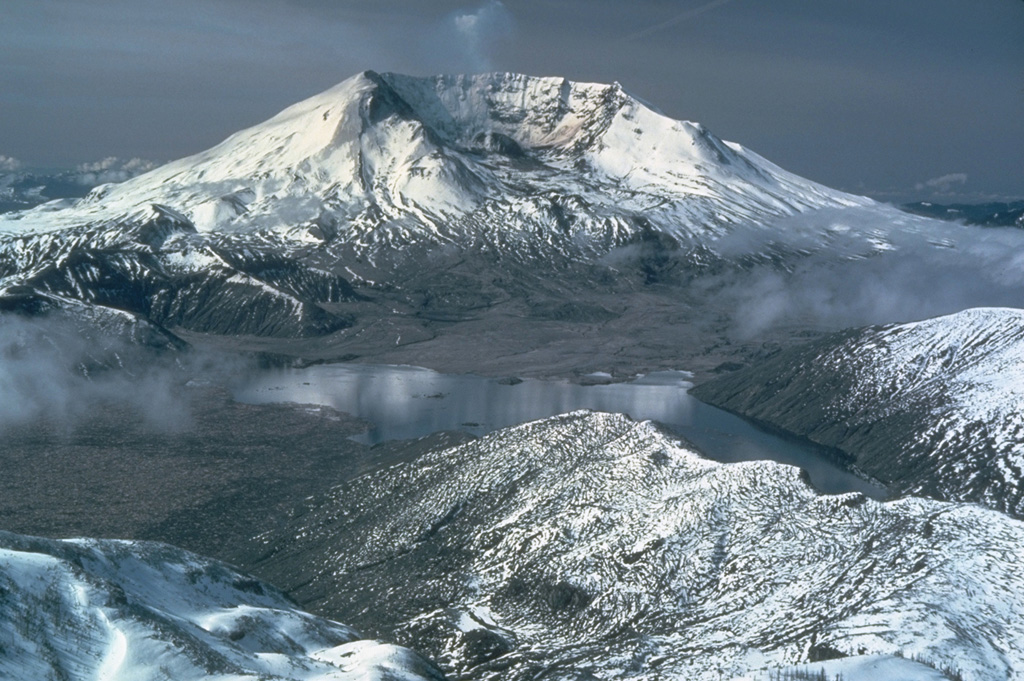
St. Helens volcano in United States
St. Helens

United States·Stratovolcano

Prior to 1980, Mount St. Helens was a conical volcano sometimes known as the Fujisan of America. During the 1980 eruption the upper 400 m of the summit was removed by slope failure, leaving a 2 x 3.5 km breached crater now partially filled by a lava dome. There have been nine major eruptive periods beginning about 40-50,000 years ago, and it has been the most active volcano in the Cascade Range during the Holocene. Prior to 2,200 years ago, tephra, lava domes, and pyroclastic flows were erupted, forming the older edifice, but few lava flows extended beyond the base of the volcano. The modern edifice consists of basaltic as well as andesitic and dacitic products from summit and flank vents. Eruptions in the 19th century originated from the Goat Rocks area on the N flank, and were witnessed by early settlers.

MetricRainierSt. Helens
TypeStratovolcanoStratovolcano
LocationUnited States · North America Volcanic RegionsUnited States · North America Volcanic Regions
Summit elevation4,392 m · 14,409 ft2,549 m · 8,363 ft
Tectonic settingSubduction zone / Continental crust (> 25 km)Subduction zone / Continental crust (> 25 km)
Dominant rockAndesite / Basaltic AndesiteDacite
Recorded eruptions2744
Largest recorded eruptionVEI 4VEI 6
Large (VEI 4+) eruptions18
Eruption record spans8,050 BCE – 1,894 CE2,340 BCE – 2,004 CE
Last known eruption1450 CE2008 CE
Coordinates46.85, -121.7646.20, -122.18
Explore

Highlighted values mark the leading volcano on that row. Elevation, type and location are from the Smithsonian GVP volcano record; eruption counts and VEI figures are computed from that volcano's full eruption list. Figures describe the recorded past only and do not forecast future activity. Tour links are affiliate links.

Height at a glance

Rainier4,392 m
St. Helens2,549 m

How their eruptions compare in size

Each volcano's Volcanic Explosivity Index “fingerprint” shows how its recorded eruptions break down by size. Two volcanoes can have erupted a similar number of times yet have completely different fingerprints — one dribbling lava, the other capable of rare, violent blasts.

Rainier

Eruption-Size Fingerprint

How Rainier's 16 size-rated eruptions break down by Volcanic Explosivity Index. Select a bar to see what that size means.

Volcanic Explosivity Index (VEI)
29 eruptions (56%)

Explosive — ash plumes reaching 1–5 km, localized impact.

Of Rainier's 16 size-rated eruptions on record, the most common was VEI 2 (9 of 16, 56%). Its record is centred on moderate explosive eruptions (VEI 2–3), with larger events far rarer. The largest on record reached VEI 4.

Based on the Smithsonian GVP eruption record. This describes Rainier's past eruptions only — it does not predict future activity. What is the VEI? · Most explosive volcanoes

St. Helens

Eruption-Size Fingerprint

How St. Helens's 23 size-rated eruptions break down by Volcanic Explosivity Index. Select a bar to see what that size means.

Volcanic Explosivity Index (VEI)
210 eruptions (43%)

Explosive — ash plumes reaching 1–5 km, localized impact.

Of St. Helens's 23 size-rated eruptions on record, the most common was VEI 2 (10 of 23, 43%). Its record is centred on moderate explosive eruptions (VEI 2–3), with larger events far rarer. The largest on record reached VEI 6.

Based on the Smithsonian GVP eruption record. This describes St. Helens's past eruptions only — it does not predict future activity. What is the VEI? · Most explosive volcanoes

Popular comparisons

How to compare volcanoes

No single number makes one volcano “bigger” or “more dangerous” than another — it depends on what you measure. A broad shield volcano like Mauna Loa dwarfs most peaks by volume yet erupts gently, while a steep stratovolcano like Vesuvius is far smaller but erupts explosively. This tool puts the meaningful metrics side by side — type, summit elevation, how many eruptions are on record, the largest size reached on the Volcanic Explosivity Index, and the most recent known eruption — so the contrast is obvious at a glance.

Reading the rows together tells the real story. A high eruption count with a low peak VEI is the signature of a frequently-active but gentle volcano; a low count with a high peak VEI marks one that erupts rarely but catastrophically. To see which volcanoes have the largest explosive records overall, browse the most explosive volcanoes ranking, or watch what is happening now on the active volcanoes tracker.

Continue exploring